The president who threatened to end a civilization is supposed to guarantee Ukraine’s survival


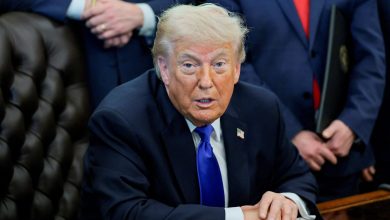
KYIV, Ukraine — On Tuesday, the president of the United States sent a message to the world. The man whose military is supposed to guarantee the survival of a 35-nation coalition in Ukraine posted on Truth Social that “a whole civilization will die tonight” if Iran did not reopen the Strait of Hormuz by his 8 p.m. deadline.
He promised to bomb every bridge and power plant in the country. Not as a warning. As an ultimatum, with a countdown, posted for the world to read along with the 93 million people he profanely threatened to annihilate.
The next day, civilians in Tehran were standing on the infrastructure he had threatened to destroy. Mothers, students, old men — they linked arms across overpasses, formed human chains around bridges and power plants, shielding them with their bodies, an NBC News video showed.
Asked whether he was concerned about war crimes, Trump told reporters he was “not at all.”
Retired American military officers said the threats themselves were likely war crimes — and that Trump had handed prosecutors a ready-made record. “He’s essentially self-incriminating,” one retired senior officer told reporters, per The Guardian.
Legal experts noted that threatening to systematically destroy civilian power plants and bridges, regardless of whether the strikes occur, can itself constitute evidence of criminal intent under the laws of armed conflict, according to The New York Times.
At the same time, White House envoys, billionaire Steve Witkoff and Trump’s son-in-law, Jared Kushner, were supposed to fly to Ukraine after Orthodox Easter this weekend carrying new security guarantees but were rerouted to Pakistan instead, for talks in Islamabad the same weekend the Kyiv visit was planned.
The administration was starting a war with one hand and promising to end one with the other. The same president who threatened to destroy civilian infrastructure in Iran on Tuesday is supposed to guarantee that no one destroys Ukrainian civilian infrastructure ever again.
“Is the U.S. going to provide Ukraine something like mutual security assistance? I don’t think so,” Ed Arnold, a senior research fellow at the Royal United Services Institute and a former British military officer, told Military Times.
“And even if they did, do the Ukrainians believe in it? And pretty critically — does Putin believe in it?”
Moscow already had an answer.
“The Americans have a lot of other things to deal with, if you know what I mean,” Kremlin spokesman Dmitry Peskov said, according to the Kyiv Independent.
“The primary movers in these so-called peace talks — the Americans — are now busy with other things,” a senior European diplomat told Military Times, speaking on condition of anonymity to discuss sensitive security assessments.
And they took the interceptors with them. The U.S. military burned through more than 800 Patriot missiles in the Middle East in three days — more than Ukraine has received in the entire war — while the production line makes roughly 600 a year.
The White House has since suspended Patriot export sales globally because of supply constraints, according to The Atlantic.
Meanwhile, the administration rolled back Russian oil sanctions — the same restrictions that had been slowly strangling Moscow’s ability to finance the war — just as the Iran conflict sent crude past $100 a barrel, opening a window for Russia to sell at wartime prices with no cap and no consequences.
“Just this easing by America could provide Russia with around $10 billion for the war,” Ukrainian President Volodymyr Zelenskyy said alongside French President Emmanuel Macron in Paris. “This certainly does not help peace,” according to Al Jazeera.
The sanctions rollback did not just weaken Ukraine’s position at the table — it actively financed the war Ukraine was supposed to be negotiating its way out of.
“This is throwing a massive lifeline to Putin,” the senior diplomat said.
Kyiv has fought harder anyway.
Its forces have recaptured more than 480 square kilometers in the southeast since January, pushing the ballistic missile interception rate toward 95%, and sent long-range strikes deeper inside Russia than at any point in the war — and for every short- to medium-range missile Russia fired in, Ukraine was sending more out.
Its forces achieved a drone advantage over Russia in what the Institute for the Study of War called a possible first in combat history, striking oil ports from the Baltic to the Black Sea.
But the Iran war has made those capabilities impossible to ignore. As Tehran launched waves of drones and missiles across the Middle East, nations scrambling to respond found themselves watching Ukrainian-developed systems do what their own could not — handing Zelenskyy leverage overnight that years of diplomacy never had.
Ukraine’s long-range drones have knocked out an estimated 40% of Russia’s oil export capacity, around 2 million barrels per day offline, in one of the most severe oil supply disruptions in the modern history of Russia, according to Reuters.
Washington did not celebrate any of it. The administration told Kyiv to stop striking, and the same week, Vice President JD Vance flew to Budapest to campaign for Hungarian autocrat Viktor Orbán — Putin’s closest partner in the EU — while accusing European allies of election interference.
Zelenskyy confirmed that allies had sent Ukraine “signals” about scaling back strikes on Russia’s oil sector, per Reuters. The State Department formally warned Kyiv’s ambassador to quit the attacks.
“Having severed most support to Ukraine, undermined the trust of its allies and made clear that it will avoid applying any serious pressure on Russia, Washington is rapidly bleeding leverage,” Arnold wrote in a recent RUSI analysis.
But the Iran war may have had the opposite effect on Ukraine’s standing, Arnold told Military Times. The country Washington is pressuring to stop fighting has just demonstrated that its technology works and America’s deterrence does not.
In the space of weeks, Washington has eased the sanctions squeezing Russia’s war budget, told Kyiv to stop the strikes crippling its oil exports and conditioned security guarantees on surrendering territory Ukrainian soldiers are still holding — a sequence that, to the allies watching it unfold, has looked less like negotiation than an attempt to dismantle Ukraine’s leverage piece by piece.
The war in Iran, the peace deal in Ukraine, stability in the Far East — all of it seems to run through one man in the White House, the senior diplomat said, who does not seem to worry about the long-term consequences of his global actions.
“You’ve pushed a domino in the dark,” he said.
“You have no idea which other dominos are lined up, who’s in the line of fall, what you’re going to face as a consequence — because you looked at this problem in complete isolation.”
Read the full article here