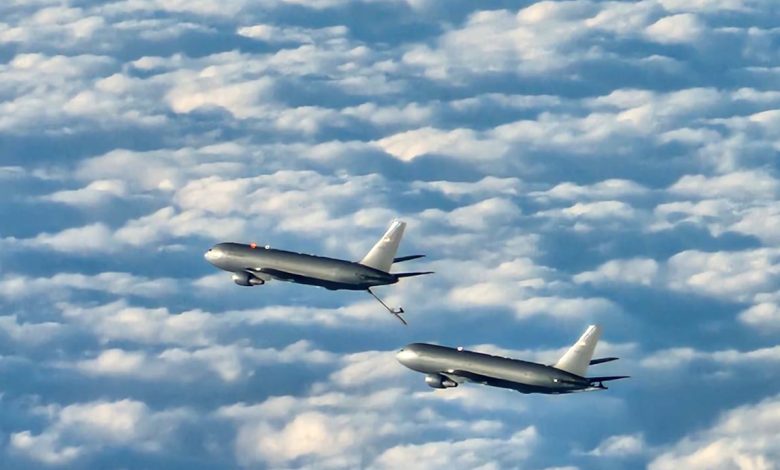

The Air Force is asking Congress for $3.9 billion to buy 15 Boeing KC-46A Pegasus tankers in fiscal 2027, an $800 million increase over fiscal 2026, according to Air Force budget materials released April 21. Annual procurement is expected to rise to 18 aircraft per year from 2028 to 2031.
The service also clarified plans for the size of its KC-46 fleet. Procurement figures in the fiscal 2027 budget document initially indicated a goal of 319 aircraft, but the Air Force corrected that number on April 24, confirming the program of record is 263 KC-46As, Defense Daily reported.
The expansion runs through the Tanker Production Extension program, which extends Boeing’s existing KC-46 contract rather than launching a new competition for a “bridge tanker” that Airbus and Embraer had hoped to bid on.
“The KC-46 is planned to fully replace the Air Force’s KC-135 fleet, providing critical refueling capabilities to project power, maintain strategic deterrence, and defend the Homeland,” the Air Force said in a statement. Budget justification documents show a unit cost of $199.8 million in fiscal 2027, rising to $321.9 million in fiscal 2028.
Even as the service commits to a long-term investment in the aircraft, the program’s technical problems persist. In May 2025, then-Air Force Chief of Staff Gen. David Allvin told the House Appropriations defense subcommittee that the KC-46 still has five Category 1 deficiencies, two of which stem from the Remote Vision System. The replacement system, RVS 2.0, is now projected to be fielded in summer 2027 — three years behind its original schedule.
Air Force budget materials state that the service expects all KC-46 shortfalls to be resolved by 2028. To date, Boeing has absorbed more than $7 billion in losses on the KC-46 under the program’s firm fixed-price development contract.
The fiscal 2027 request arrives as Operation Epic Fury exposes how heavily the joint force depends on aerial refueling. Tanker crews have sustained near-continuous airborne presence over the Middle East throughout the operation, refueling fighters and bombers operating against Iranian targets.
That demand has come at a cost. An Iranian missile strike damaged multiple KC-135s on the ground at Prince Sultan Air Base in Saudi Arabia, while another went down in western Iraq on March 12 during a refueling-related incident. It was the first loss of a U.S. Air Force tanker in more than a decade. U.S. Central Command said the incident was not due to hostile or friendly fire.
The fiscal 2027 request also redirects Next-Generation Aerial Refueling System funding toward a new Advanced Tanker Systems effort focused on mission systems and survivability upgrades rather than a new airframe. Operational fielding of a next-generation tanker remains unlikely before the mid-2030s.
Read the full article here