
For the first time in service history, the Coast Guard is set to roll out physical fitness testing requirements to the entire force. And, officials say, the service’s most senior officers will be the first to see the test factored into their performance and promotability reporting.
A 29-page guide, which has yet to be publicly released, lays out the components of the Coast Guard’s physical readiness program and testing, which will be a twice-annual requirement for all service members beginning July 1.
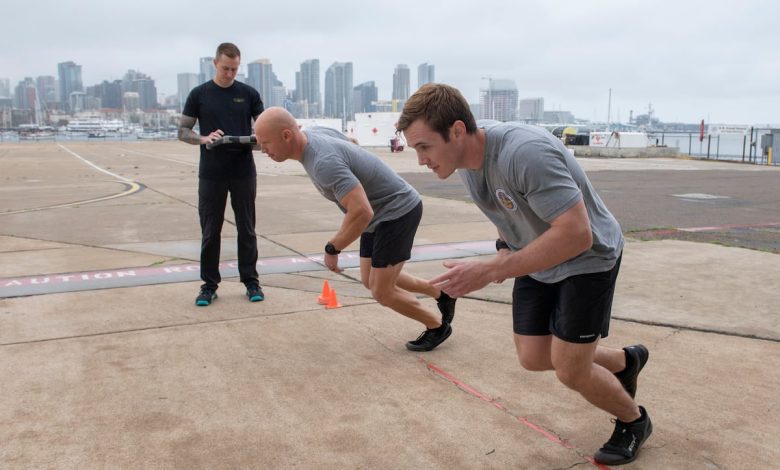
The test requires takers to perform as many push-ups as they can in one minute; hold a forearm plank as long as possible, up to 3 minutes and 24 seconds; and complete their choice of approved cardio events, with options including a 1.5-mile run for time, a 2000-meter row or a 500-yard or 450-meter swim.
While the test will soon be mandatory for all on a non-scored basis, senior Coast Guardsmen and officers will be held to the new testing standard much sooner than enlisted Coasties, Capt. Christopher Hulser, Chief of Staff and Executive Assistant to the Commandant of the Coast Guard told Military Times in an exclusive interview.
The service’s admirals and “gold badges,” or senior enlisted advisors, are already taking the test and reporting the results, Hulser said.
“No service has ever done that before,” he said. “It’s just been a, ‘hey, we’re doing this as a service.’ But we feel strongly that, because this is the first time we’re introducing it, we want our leadership to be done first.”
Coast Guard officers will be scored starting July 1, when the formal rollout begins; but enlisted troops may have until January 2028 to build familiarization and train for the test, he said.
“We have to figure out the exact right date for them to start,” Hulser said. “But one year feels like a good time for officers to have reported on their evaluations during two different cycles, because some are on six-month evaluations, and then our enlisted members will follow.”
Historically, Coast Guard troops have had to stay within set body composition standards, but any physical fitness requirements have been set on a job-specific basis — for example, standards applicable to the mission demands of the elite Coast Guard rescue swimmers. In January, the service announced it was setting a new course, and requiring commanders to set aside dedicated workout time for their troops along with the fitness test rollout.
“Right now, we’re at a time of renewal,” Hulser said. “There’s been an unprecedented amount of resources flowing to the Coast Guard. There’s an unprecedented amount of focus on the Coast Guard. And I think the service is enjoying a prominence that we haven’t had before, not in my service lifetime.”
Hulser added he believed the service had always needed the test, though, to help service members maintain their health throughout their military career and beyond.
When choosing events to include, the service looked to best practices from the military and law enforcement, Hulser said, ending up with a modifiable test that emphasizes cardio endurance and upper body and core strength. Another requirement, he said: the test had to involve minimal equipment.
“Our members are not held in garrison most of the time,” he said. “Our members are out there literally doing their jobs. They’re on Fast Response cutters, they’re in a helicopter … we honestly don’t have access to some of the expansive gym equipment and gyms that [the Department of Defense] has, so all of our activities, we wanted them to be confined to, that they could train on their own.”
The test is age- and gender-normed, with scoring for each event graded on a scale of 1 to 7. Each event requires a score of 45 points, a grade of 4, to pass. To max out the test with a score of 100 and a grade of 7, a 17-to-19-year-old male would need to complete 67 push-ups, execute a 3:24 plank, and complete the 1.5-mile run in eight minutes, 15 seconds. To pass with a minimum score, he would have to complete 30 push-ups, do a 1:11 plank, and finish the run in 12:45.
Hulser indicated that the test could still change as the service continues to evaluate. He didn’t rule out specialized exercises adopted by services like the Army, but emphasized the need for simplicity in starting out.
“That new way of doing push-ups, where you pause at the bottom? I’m like, ‘Hey, look, that’s great. Step two stuff,” Hulser said. “There’s probably medical science saying we should do that. Maybe in version 2.0. But for now, let’s keep it simple. Let’s start to increase the baseline level of physical readiness in the Coast Guard.”
Starting in January he said, the service had allowed members to take the new physical fitness assessment anonymously, providing their scores to the Coast Guard as a data point. Some 43,000 Coasties participated in the PFA and 37,000 took the full test, Hulser said.
“We had about an 88-90% pass rate across the board,” he said. “That’s not the pass rate we want in the future. I think we want upwards of 95-96%, on par with the other services.”
Hulser acknowledged that requiring commanders to make time for their service members to work out daily had generated some concerns amid high operational tempo, but maintained that the Coast Guard “can’t afford not to do it.”
He said he’s been heartened in the last year to see gyms around the service fill up as Coasties anticipate the new challenge.
“There’s this old saying that what can be measured, can be improved,” he said.
Read the full article here