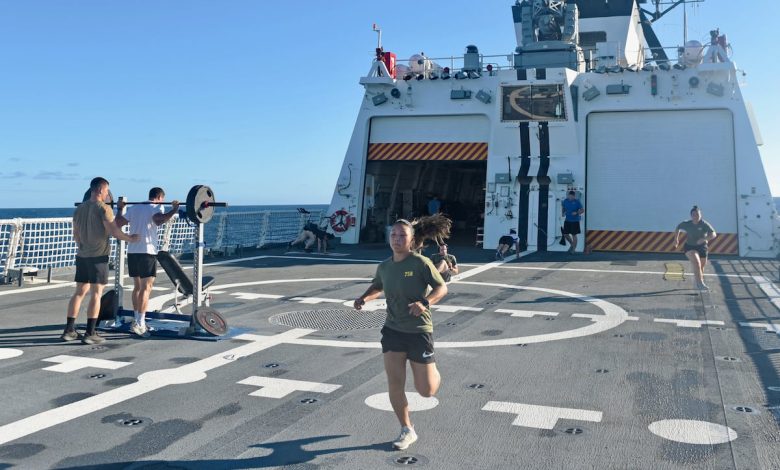

As the Coast Guard rolls out its first-ever universal physical fitness test, leaders are eyeing incentives for acing it.
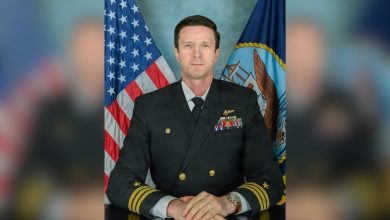
The service, which will debut a mandatory three-event physical fitness assessment July 1, also plans to introduce a medal for those who receive top scores, said Capt. Chris Hulser, chief of staff and executive assistant to the commandant of the Coast Guard.
The test, which includes maximum push-ups in a minute, a plank for time and a timed 1.5-mile run or comparable cardio event, is relatively easy to pass, but challenging to max. For a male aged 17-19, getting a maximum score of 100 in each event requires 67 push-ups; a 3-minute, 24-second plank; and an 8-minute, 15-second run, or 5 minutes, 30 seconds per mile.
“What we wanted to do is introduce, ‘Okay, here’s what you’ll be held accountable for, but here’s where you can excel,’” Hulser told Military Times in an interview. “The Army actually has a ribbon and a medal for physical readiness excellence. We’ll have those things set up as well, just to try and get people to create a culture of winning.”
An upcoming all-Coast Guard message to be released next month will contain an illustration of the new award, he said, though it will probably be about a year in development, Hulser said.
The Army, the only military service that offered an award for fitness excellence, did so in the form of a physical fitness (or PT) badge granted to soldiers who scored a minimum of 270, or at least 90 out of 100 on each of three events on the old Army Physical Fitness Test.
The APFT was phased out in 2020 and replaced by the Army Combat Fitness Test, or ACFT, which will be replaced by the new Army Fitness Test in June. Updated PT badge criteria have not been published.
In 2015, Navy officials proposed a uniform-worn Outstanding Fitness Award to recognize high achievers on the Physical Fitness Assessment. Ultimately, though, the service never developed the award.
As the Coast Guard seeks to promote fitness excellence across the service, it may also combine the new twice-annual fitness testing regimen with body composition assessments, Hulser said. While other military services monitor body composition via height and weight or circumference measurements as part of their fitness program, the Coast Guard has treated body composition as an administrative function.
“When you think about it, why have we kept them separate? Well, because we haven’t had a physical readiness program,” Hulser said. “So we’ve only had half the pie there. I personally would like them to merge in the future, because if you want to look at someone’s holistic health, their weight … how much visceral fat they’re carrying is a big part of it.”
To prepare Coasties for the new test, the service has also shipped more than 1,000 pieces of cardio workout equipment to installations and built a new school for “physical readiness leaders” in Elizabeth City, North Carolina, Hulser said.
“We fielded 1,200 pieces of equipment … so rowers, treadmills, all within the last nine months,” Hulser said, adding that delivering rowing machines to Coast Guard Station Valdez, Alaska, for example, required airlift by C-130 transport.
“This isn’t trillions of dollars … this is millions of dollars. But the Coast Guard’s really putting an emphasis where it says it needs to be.”
The new training school, housed under the Coast Guard’s Athletic Performance Branch, has already churned out 1,500 physical readiness leaders, a newly created credential, Hulser said. By July 1, he added, the service wants to have minted 3,000 PRLs, out of a total force of roughly 50,000.
“These 3,000 people will be distributed across the Coast Guard, coordinating those activities, administering the PFT, and then also helping people remediate,” Hulser said. “Because this isn’t the type of thing where, if you fail, you’re separated from the Coast Guard the next day. We want to give people a lot of time to train to a standard so that they can be as healthy as they can be.”
Read the full article here