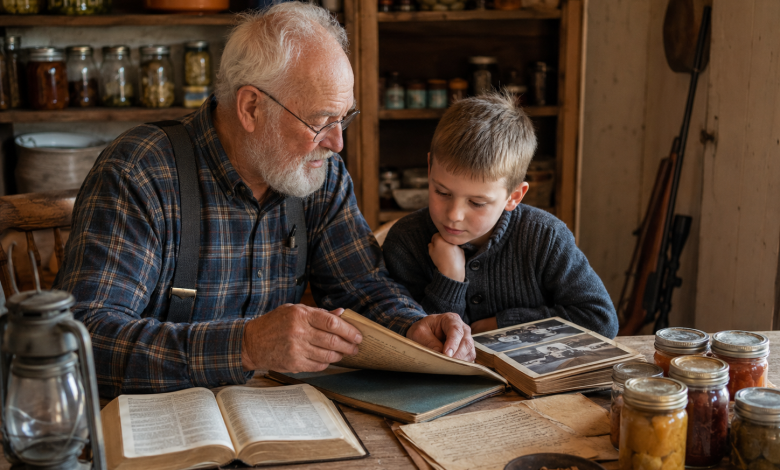

A man can leave his grandchildren a rifle, a pantry, a hand pump, and a stack of old tools. Those things have value. Good gear, useful land, and a well-built home can bless a family for years.
Still, one of the strongest things a man can leave behind is a story.
The stories a family carries shape how the next generation sees hardship. They teach children what kind of people they come from. They show them how their grandparents endured loss, hunger, war, sickness, failure, faith, hard work, and rebuilding.

Supplies can run out. Tools can break. Land can be sold. A good story, passed down clearly, can keep giving strength long after the person who lived it is gone.
1. Your Family History Is A Survival Tool
Every family has stories that explain who they are.
Maybe your grandfather made it through the Great Depression by stretching beans, bread, and garden vegetables. Maybe your grandmother raised children with almost nothing and still kept a clean table and a prayerful home. Maybe your parents lived through war, layoffs, illness, or long seasons when one bad bill could have ruined everything.
Those stories are not just memories. They are maps.
They show younger people that hardship has come before and families have survived it. They show that fear, grief, and uncertainty are part of life, and that ordinary people can keep moving with faith and discipline.
A child who hears only comfort stories may grow up thinking struggle means failure. A child who hears survival stories learns that struggle can be endured.
2. Gear Without Wisdom Is Fragile
Preppers often spend years gathering supplies. That makes sense. A family should have food, water, medicine, tools, heat, and ways to protect itself.
Yet gear alone cannot teach judgment.
A grandson may inherit a workshop full of tools and still have no idea why his grandfather kept them sharp, oiled, and organized. A granddaughter may inherit jars, recipes, and a pressure canner without understanding how her grandmother learned to preserve food after a lean year. A family may inherit land without knowing which spring ran dry, which field flooded, or which neighbor showed up when the barn roof failed.
The story gives meaning to the object.
Tell your grandchildren why you stored what you stored. Tell them why you planted fruit trees. Tell them why you learned to fix instead of replace. Tell them why you kept cash, firewood, water, seeds, and old books.
Those explanations turn supplies into wisdom.
3. Hardship Stories Build Courage
Children need to know that the people before them faced hard things.
They need to hear about the winter when money was short. The storm that took the power out for a week. The crop that failed. The job that disappeared. The sickness that changed family plans. The year when faith was tested and pride had to be swallowed.
These stories should be told with honesty and steadiness. There is no need to make them dramatic. The truth is usually strong enough.
Tell them what happened. Tell them what you did. Tell them what you learned. Tell them where you failed. Tell them how God provided, how neighbors helped, and how the family adjusted.
A good hardship story does not leave a child afraid. It leaves him with a deeper sense of courage. He begins to understand that hard times do not have the final word over a faithful and disciplined household.
4. Faith Needs To Be Remembered Out Loud
Many families lose their faith story because nobody says it plainly.
A grandmother prays for forty years, but no one writes down the answered prayers. A father carries the family through a crisis, but never explains how Scripture steadied him. A mother keeps hope alive through years of worry, but her children never hear the full story of what it cost her.
Faith should be remembered out loud.
Tell your grandchildren the verses that carried you. Tell them about the time you had no good answer and prayed anyway. Tell them about the neighbor who became a blessing. Tell them about the season when you learned humility, patience, forgiveness, or trust.
A family that records its faith gives the next generation something solid to hold when their own storms arrive.
5. Write Down The Ordinary Details
Do not wait for a perfect war story or a dramatic disaster.
The ordinary details may matter most.
Write down how your family cooked when money was tight. How your father sharpened a knife. How your mother stored potatoes. How your church helped a family after a fire. How neighbors shared tools. How children entertained themselves before screens. How your grandparents treated Sunday, work, debt, food, and promises.
These small details reveal a way of life.
Your grandchildren may one day live in a world where simple knowledge becomes valuable again. They may need to know how families once stretched meals, repaired clothing, cared for elders, raised children, and kept morale alive without constant entertainment.
What feels ordinary to you may become precious to them.
6. Record Stories In Simple Ways
You do not need expensive equipment or a polished family history book to begin.
Start with a notebook. Write one story each week. Keep each one short if that helps. A few paragraphs are better than silence.
You can also record your voice on a phone. Sit with an older relative and ask simple questions. What was the hardest year you remember? What did your family eat when times were tight? Who helped you when you needed it? What did your parents teach you about work? What did faith mean in your home?
Save those recordings in more than one place. Print some stories on paper. Put copies with important family documents. Give each child or grandchild a copy when the time is right.
Paper still matters. A digital file can disappear. A printed story in a family Bible, binder, or metal box may survive much longer.
7. Teach Through Family Meals
Stories travel best when families sit together.
A meal gives children a natural place to listen. Tell one family story over Sunday dinner. Tell another while canning, gardening, fishing, or stacking wood. Let the story connect to the work.
If you are planting potatoes, talk about how your grandparents grew food. If you are filling water jugs, tell about the storm that taught you to store water. If you are making soup from leftovers, talk about thrift and gratitude.
This is how wisdom becomes part of family life. It becomes attached to smells, places, tools, and meals. Children remember that.
8. Include Failure And Repentance
A good family legacy should be honest.
Do not pass down only the victories. Tell the failures too. Tell about the time pride cost you. Tell about the debt you regret. Tell about the shortcut that created more work. Tell about the season when you had to apologize, rebuild trust, or start over.
Those stories may be the ones your grandchildren need most.
They teach that a good life is not a life without mistakes. It is a life where a person learns, repents, repairs what he can, and keeps walking.
That kind of honesty gives descendants permission to become stronger instead of pretending to be perfect.
9. Leave A Blessing, Not Just A Record
Before the stories are finished, tell your grandchildren what you hope for them.
Tell them to be faithful. Tell them to work hard. Tell them to protect their families. Tell them to love their neighbors. Tell them to fear God more than they fear the times. Tell them to stay useful, humble, and steady.
A blessing can be spoken. It can also be written.
A letter from a grandparent may become one of the most valuable things a young person ever owns. Long after tools rust and money is spent, those words may remain.
10. The Legacy Worth Leaving
Preparedness should reach farther than one lifetime.
If all we leave behind is gear, our descendants may have supplies without direction. If we leave stories with the gear, they inherit examples, warnings, courage, and faith.
That is a different kind of wealth.
So write the stories down. Record the old voices. Ask questions while the elders are still here. Tell the children how the family endured. Tell them what God brought you through. Tell them what mistakes to avoid and what duties to keep.

One day, your grandchildren may face their own hard season. When they do, they may open a notebook, hear an old recording, or remember a story told at the table.
And they may realize they come from people who endured.
That knowledge can steady a young soul when the world shakes.






Read the full article here