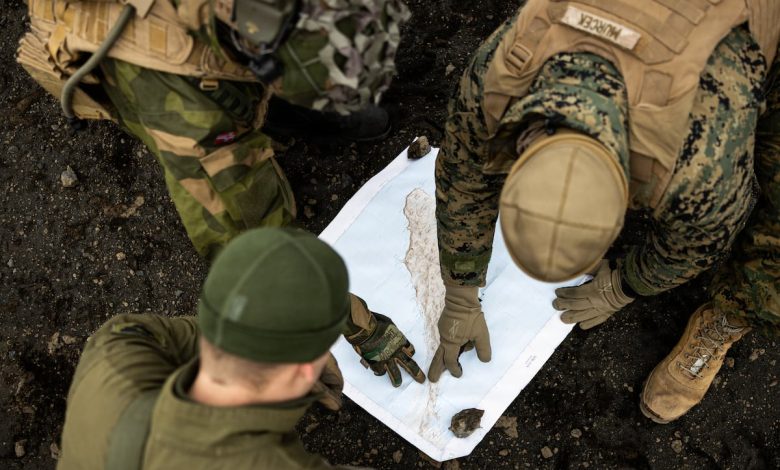

U.S. Marines participated in a “first-of-its-kind mission” in the remote Arctic this summer, meant to test their ability to work with Norwegian and British troops in harsh conditions.
The operation — on the far-flung and strategically valuable island of Jan Mayen, Norway — reflects NATO’s increasing focus on the Arctic, where the alliance is worried about Russia’s ability to project power and disrupt critical infrastructure. The exercise also gave Marines a chance to practice defending “key maritime terrain” with tactics they refined in the Pacific.
Dubbed Operation Atlantic City, a reference to a WWII-era U.S. base on Jan Mayen, the Norwegian-led exercise ran from Aug. 26 to Sept. 4 and marked the first instance of “rapid insertion of military assets to remote and austere locations,” the Marine Corps said.
A news release described the exercise as focused on developing expeditionary advanced basing capabilities and on testing participants’ ability to conduct combined fires missions, provide maritime domain awareness and deny adversaries the use of nearby sea lanes. It was a demonstration of the militaries’ ability to “integrate multinational sensors, command-and-control nodes, and precision fires into a unified, joint kill web.”
Training with weapons that could challenge enemy air and naval movements appeared to be a major element.
At the start of the exercise, a U.S. Air Force C-17 transported a U.S. Navy Containerized Launching System — a 40-foot container with four launch cells for anti-air and anti-ship missiles — to Trondheim in central Norway in a strategic airlift mission to demonstrate “rapid projection of joint logistics and interoperable communication assets.”
U.S. and British cargo aircraft also transported vehicles and equipment — including U.S. Joint Light Tactical Vehicles, a Norwegian National Maneuver Air Defense System, and an Australian Strikemaster anti-ship-missile system operated by Marines — to Jan Mayen as part of the rapid-insertion training.
The vehicles were moved around the island to test troops’ ability to position and protect assets on rough and contested territory. Those platforms were also employed to relay targeting data and communications as part of what the Corps calls “a resilient kill web” comprising dispersed weapons and command-and-control nodes. Other drills, like the delivery of medical supplies using an aerial drone, underscored the exercise’s expeditionary focus.
Holding ‘key maritime terrain’ at risk
A mountainous island 620 miles from mainland Norway with an active volcano and partially covered by glaciers, Jan Mayen is uninhabited except for a few dozen Norwegian military personnel and Norwegian Meteorological Institute staff.
But it is a strategic outpost in waters “vital to NATO in terms of securing international sea lines of communication and transatlantic supply routes,” a Norwegian official said after Operation Atlantic City 2025.
The 2025 version of the exercise was the first time Marines operated on Jan Mayen, according to Lt. Col. Kurt Stahl, communications director for US Marine Corps Forces Europe. That came after an apparent lull in U.S. activity there since late 2019, when airmen visited to do an airfield assessment.
This year’s Atlantic City was “quite significant” because it was the second consecutive year Marines ventured to the island, Stahl added.
Jan Mayen provides a “true austere island location” where Marines can train on inhospitable but important terrain, said Lt. Col. David Palacio, fires officer for Marine Corps Forces Europe.
“This year it was absolutely an integrated force, whether that was in targeting, intelligence, communications, also medical capabilities, which will be a concern in any type of austere and isolated environment like this,” Palacio said in a video released after the exercise, adding that troops were “really integrating significantly more than last year.”
Atlantic City 2026’s content and location were reminiscent of Marine Corps exercises with allies in the Western Pacific.
Over the past several years, Marines have deployed to Philippine and Japanese islands with sensors and weapons — notably the NMESIS anti-ship missile — that would allow them to monitor and control sea lanes and airspace around Taiwan that China would need to use in a conflict.
Atlantic City 2026 was meant to ensure Marines in Europe could do similar tasks.
The Joint Light Tactical Vehicle delivered to the island on a British cargo plane “was really being used as a surrogate for” NMESIS, Palacio said in another video. “So we were validating that this vehicle can fit on this aircraft and can be delivered rapidly to this location, which we did flawlessly.”
The message of Atlantic City 2026 was also similar to that of the exercises on Japan’s southwest islands and in the northern Philippines: “It’s important for the adversary to know that, ‘Hey, this is a thing out here as well, too, so you’re not going to get sanctuary in areas that you thought,’” Palacio said. “‘That key maritime terrain that you thought you could just bypass? You now have to understand that you’re being held at risk.’”
Approaching Russia’s ‘bastion’
Atlantic City 2026 also reflects NATO’s shift toward the Arctic.
The exercise ran concurrently with Northern Viking, a NATO exercise focused on defending Iceland and sea lanes between Greenland, Iceland, and the UK — a chokepoint known as the GIUK Gap — and was part of NATO’s new Arctic Sentry initiative, which is a response to “Russia’s increasing military activity and China’s growing interest in the Arctic,” the alliance said.
“Over the last three, four, five years, allied activity in the Arctic has more than doubled, so there’s a lot of interest in the Arctic,” Maj. Gen. Øivind Gunnerud, chief of the Royal Norwegian Air Force, said during an event at Norway’s embassy in Washington, D.C., in mid-September.
Russia “is the most important military factor shaping our planning in the High North. It retains strategic, significant capabilities close to Norway,” including the powerful Northern Fleet, long-range aviation forces and advanced air and missile systems, Gunnerud said.
NATO also has growing concerns about Moscow’s ability to disrupt critical infrastructure, particularly undersea data cables, in the Arctic and North Atlantic.
NATO used the GIUK Gap as a vantage point to track Soviet submarines during the Cold War, and Moscow’s investment in its submarine force over the past two decades has given the chokepoint new relevance, but the interest in Jan Mayen is a sign that the alliance’s focus is moving farther north — closer to the Barents Sea, a “bastion” from which Russian subs could potentially strike targets in Europe with conventional and nuclear-armed missiles.
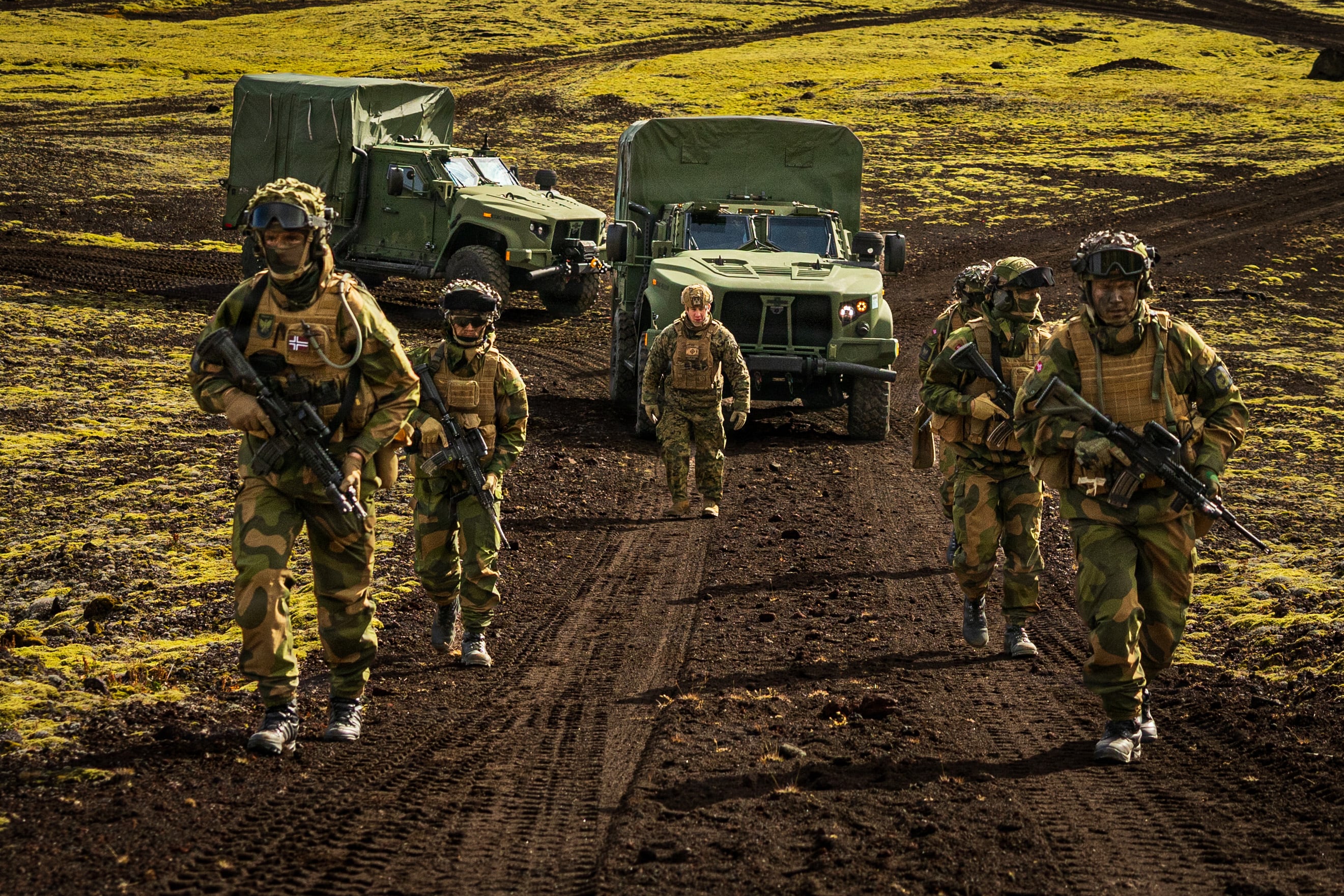
Norway has led the way amid NATO’s shift to the north.
In the coming years, the country will field new coast guard vessels designed for the Arctic, as well as new frigates and submarines. Paired with P-8 patrol planes that are already “flying constantly,” those ships will help in the “cat-and-mouse game up there to keep track of the submarines,” Gunnerud said.
Norway is also investing more in Jan Mayen. Even before Russia invaded Ukraine in 2022, Oslo invited allies to visit the island, and since then it has made plans to bolster its military posture and authority on the island. A planned undersea-cable project will also improve connectivity with mainland Norway.
“Norway has unquestionably escalated” its presence on and funding to Jan Mayen, wrote Klaus Dodds and Caroline Kennedy-Pipe, professors and Arctic security experts, in a recent report for the Royal United Services Institute.
“This was in part brought about in response to the Russian invasion of Ukraine in 2022, and it has seen a distinct change in the character of presence on the island,” they added. “From its long-standing duties as a meteorological outpost, it is now a crucial site of Norwegian security activity.”
Read the full article here