Eugene Morrison Stoner was born in Gosport, Indiana, on 22 November 1922. He passed away in Palm City, Florida, in 1997. In the intervening 74 years, Stoner established himself as the most successful American firearms designer of the modern age.
When Stoner graduated from High School in 1939, his parents could not afford to send him to college. Instead, he took a job as a machinist with the Vega Aircraft Company. Vega ultimately morphed into Lockheed, which then became Lockheed Martin. They build F-35s and C-130s today.
With war clearly on the horizon, Stoner joined the Marines. He served in the Pacific Theater as an armorer working on large-caliber automatic weapons. Along the way, he developed an abiding passion for firearms. This guy was a born gun nerd.
Though he never attended college or trained as an engineer, Gene Stoner obviously had a gift for mechanical things. After the war, he took a job in the machine shop for Whittaker Controls Inc., a company that produced aircraft components. In short order, he became their principal Design Engineer.
Foundations
George Sullivan worked as a patent lawyer for Lockheed. Charles Dorchester was his brother-in-law. They were gun nerds, too.
Sullivan and Dorchester set about incorporating aviation engineering and materials science that had emerged from the recent global war into the world of small arms. Their first project was a fairly pedestrian bolt-action hunting rifle that incorporated exotic-for-the-day fiberglass, stainless steel, and aluminum components. They called their revolutionary lightweight rifle the AR-1 Para-Sniper. You’ve got to give them credit for cool points.

These two men met Richard Boutelle through an acquaintance at a trade show. Boutelle was a veteran of the U.S. Army Air Corps and also a fellow gun nerd. Coincidentally, Boutelle was also the president of Fairchild Engine and Airplane Corporation. They built the C-119 and C-123 cargo aircraft and, eventually, the famed A-10 Warthog ground attack plane. Fairchild had some proper resources.
With Richard Boutelle’s patronage, they founded a tiny small arms design group under the overarching umbrella of Fairchild. The company was housed in a small machine shop on Santa Monica Boulevard in Hollywood. It’s hard to imagine that you could once design and build guns in California, but these were obviously different times.
Serendipity
One April afternoon in 1954, George Sullivan was out testing a prototype firearm at the Topanga Canyon Shooting Range. Gene Stoner was at the same range just turning ammunition into noise. These two guys struck up a conversation that blossomed into a friendship. Sullivan hired Stoner on the spot. He was the company’s ninth employee.

Gene Stoner designed several weapons for the company, including the AR-3, AR-5, AR-9, AR-11, and AR-12. The US Air Force bought a few AR-5s as aircrew survival rifles, but none of the others amounted to much. Then the heavens opened up, and angels began singing.

In 1955, Stoner crafted his masterwork. The 7.62x51mm AR-10 combined cutting-edge materials science with several existing revolutionary gun designs. The direct gas impingement system came from the Swedish AG-42 Ljungman rifle. The in-line geometry wherein the recoil vector traveled directly from the bore into the firer’s shoulder was simply the clever application of fundamental physics. The AR-10 changed the way the world looked at tactical guns.

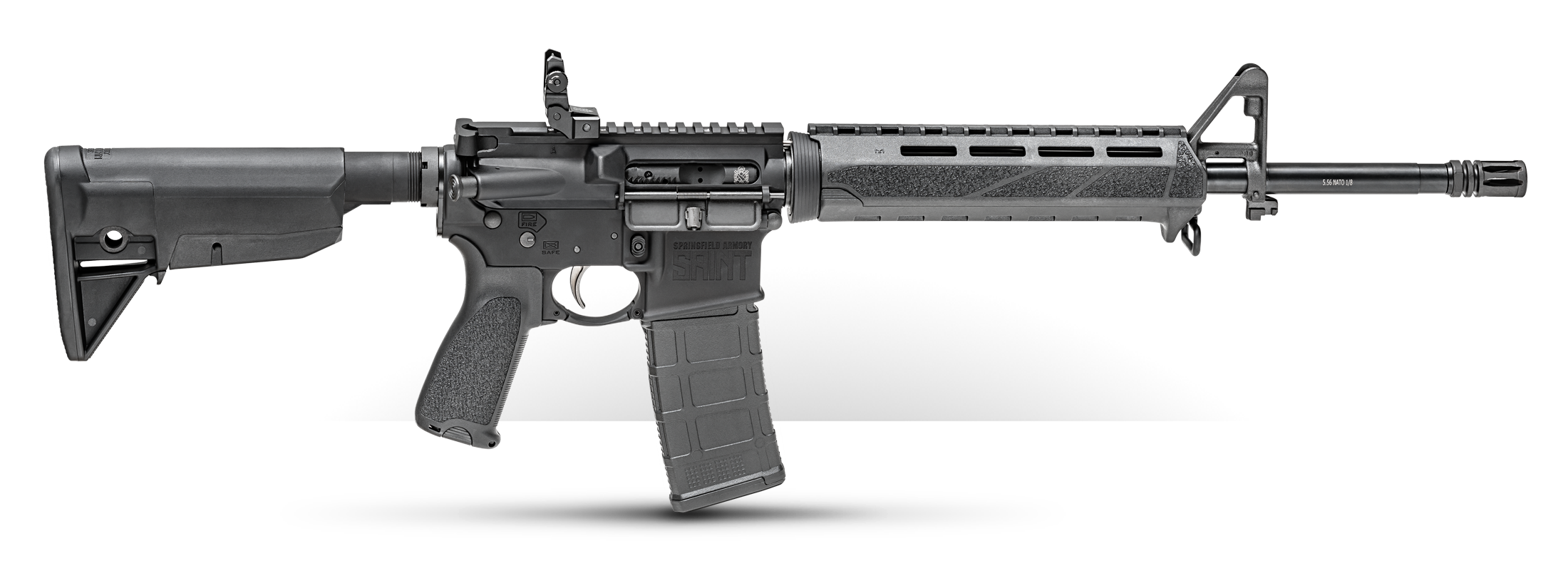
You all know the rest of the story already. The 7.62mm AR-10 morphed into the 5.56mm AR-15, which begat the M16, which became the M4. Along the way, Springfield Armory adapted the basic design into its superlative line of SAINT modern sporting rifles. The M16 in all its sundry forms is the longest-serving combat rifle in American history. The AR-15 is the most popular civilian rifle in America. It’s quite a legacy.
Details
Uncle Sam wasn’t terribly keen on the AR-10 early on. There was a tepid effort to include the AR-10 alongside the T44 and T48, guns that became the M14 and the FN FAL, during the U.S. Army service rifle trials back in the 1950s. However, there was a burst barrel in the AR-10, and it fell out of the running. The tech was not quite mature by then.

The geniuses behind the AR-10 never intended to mass-produce guns. They were a think tank. Their mission was to design cutting-edge combat guns that could then be licensed to existing production facilities. Their first serious deal was with a Dutch company called Staatsbedrijf Artillerie Inrichtingen.

Please don’t ask me how to pronounce that. However, these guys had the means to make weapons in respectable quantities. The Dutch AR-10 production ran for five years in the early 1960s. About 5,000 of these early AR-10s entered service with Portuguese Paratroopers. Most of these guns saw action in Africa. By all accounts, these radically advanced battle rifles performed swimmingly. However, not a lot of them survived to come home.
A Fortuitous Turn of Events
There’s a Biblical parable in the book of Matthew that reads, “The kingdom of heaven is like treasure hidden in a field. When a man found it, he hid it again, and then in his joy went and sold all he had and bought that field.”

Live The Armory Life. The latest content straight to your inbox plus an automatic entry to each of our monthly gun giveaways!
It’s an admittedly awkward analogy, but I live on sites like GunBroker.com. GunBroker is like the world’s biggest gun show running 24/7. One day, while surfing around, something unusual caught my eye.
The rifle in question was the world’s most expensive repurposed parts gun. The parts kit started as one of those original Dutch AR-10 service rifles made back in the 1950s. Some enlightened individual imported the demilled gun and then built it up again on what appears to be a one-off lower receiver. I had never seen one before.

I didn’t have a great deal of money at the time, but I knew I would likely never see one of these again. I emptied the piggy bank and searched under the couch cushions for spare change, and eventually made this gun mine. It is indeed a treasure.
Particulars
In this old Dutch AR-10, you can see vestiges of greatness. The gun is in excellent shape. The internal components are all hard chromed, something that should have carried over to those Vietnam-era M-16s. The charging handle is a trigger-like appendage located inside the carry handle that does not reciprocate with the action. Pressing the charging handle down locks it to the bolt carrier, functioning as a forward assist device.

The rear sight is drum-adjustable for elevation in the manner of later M-16A2 sights. The front sight blade is generously fenced. The controls are all right where we might expect them to be.
The gas system can be disabled to fire rifle grenades, and the bayonet mounts on top of the barrel. The buffer system mimics that of a modern AR-10, and the gun feeds from lightweight waffle-pattern aluminum 20-round box magazines. The furniture was formed from foam-filled phenolic polymer with some stamped steel bits added for strength. The sling swivels were mounted on the left side of the rifle rather than the bottom.

The lower receiver on my gun seems crude compared to the rest of it. Curiously, the upper receiver sports English-style pressure-proof data. Unlike that of an M4, the hammer is driven by a coil spring.
Ruminations
Gene Stoner’s very first AR-10 eventually set in motion a sequence of events that led to some 30 million or so AR-variants in service today. That legacy has carried over to some of today’s finest rifles, like the SAINT 5.56mm and 7.62mm firearms, to name just a few.
Like that treasure in the field, when I saw this one come up for sale, I knew I simply had to make it mine. Hefting this amazing old gun is like having my hands on history. And what a history it is.
Editor’s Note: Please be sure to check out The Armory Life Forum, where you can comment about our daily articles, as well as just talk guns and gear. Click the “Go To Forum Thread” link below to jump in!
Join the Discussion
Featured in this article
Read the full article here