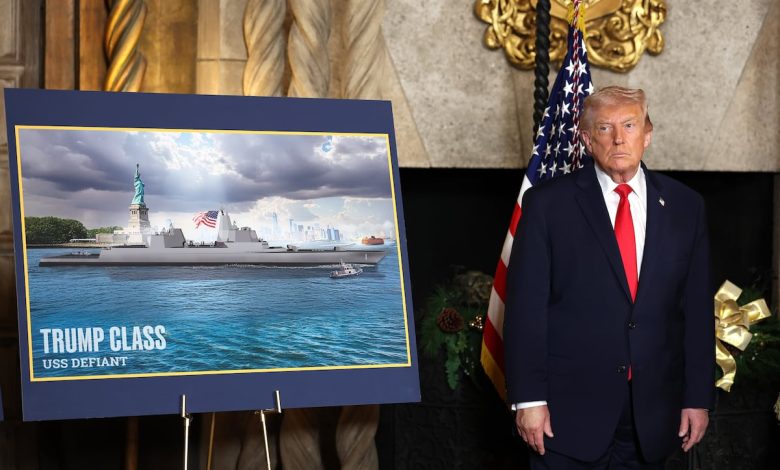

U.S. President Donald Trump calls the vessel a new class of “battleship” graced by his own name, but China just calls the U.S. Navy’s latest concept a larger and “easier target” for its growing array of anti-ship drones and missiles.
A day after Trump’s Dec. 22 announcement at Mar-a-Lago that he had ordered the construction of a “Trump class” of possibly 20 to 25 battleships, China’s Global Times, a state media outlet, carried an interview with naval researcher Zhang Junshe stating that the type of warship envisioned by Trump would be a ripe target for China’s anti-ship weapons, including the so-called “carrier killer” DF-21D ballistic missile.
“The large size of a battleship also makes it more vulnerable and potentially an easier target, particularly when it is densely loaded with munitions,” according to Zhang, a researcher at the People’s Liberation Army Naval Military Academic Research Institute.
In the wake of the announcement, some analysts suggested the battleship proposal may ultimately be not be realistic and instead a move by Trump to jolt awake the U.S. shipbuilding industry, which lags far behind China.
“We must wait and see if it can succeed,” Zhang told the Global Times, a tabloid published under the guidance of “People’s Daily,” the official newspaper of the Chinese Communist Party.
Trump’s battleship plan also appeared to draw a response from Russia. Two days after the Dec. 22 announcement, Nikolai Patrushev, an aide to President Vladimr Putin and head of Russia’s Naval Board, said in a speech that Russia had begun working on a “next-generation” nuclear-powered ballistic missile submarine, according to Russia’s Interfax news agency.
On Dec. 30, in the wake of the unveiling of the battleship concept, the non-partisan Congressional Research Service released a report estimating that the new class of ships would cost as much as $15 billion for the first to put to sea — already named the USS Defiant — with each additional ship costing about $10 billion.
In a statement shortly after Trump put forward the plan, Bath Iron Works President Charles F. Krugh said his shipyard “stands ready to fully support the Navy in the design and construction of this important new shipbuilding program.”
Chris Kastner, Huntington Ingalls president and CEO, also issued a statement, saying, “We are proud to have built the Navy’s most technologically advanced surface combatants and our shipbuilders are committed to continuing that work in lock step with the Navy to expand their Fleet.”
The biggest fan of the battleship proposal, meanwhile, might be the service’s Chief of Naval Operations Adm. Daryl Caudle, who said Wednesday at the Surface Navy Association Symposium that he views the battleship as the centerpiece in the formation of a “Golden Fleet” which “will anchor maritime fires and sea control in the most contested environments, massing durable combat power and absorbing punishment an adversary cannot match.”
Caudle also said the Navy has a lot of catching up to do in keeping pace with China, but that will depend on the ability of the shipyards to speed up production.
“It is not happening at the pace any of us are satisfied with,” Caudle said. “I am pressing hard with [Navy Secretary John Phelan] to accelerate deliveries in 2026 and beyond. I want more hulls in the water, and I want them there faster.”

Caudle noted that the Navy’s “Battle Force stands at roughly 290 ships, with about 100 deployed worldwide on any given day.”
That number stands in contrast to projections contained in the Pentagon’s recently released Annual Report to Congress on Military and Security Developments Involving the People’s Republic of China, which estimated the number of surface warships and submarines in service to Beijing to be at 370.
At the symposium Wednesday, Caudle gave a grim forecast, considering that near-peer fleet, on what the next fight at sea might look like.
“Let me be absolutely clear about that fight,” he said. “It will be faster, more distributed, more lethal and far less forgiving than anything we have faced in our lifetimes.
“There will be no rear area. There will be no sanctuary. There will be no ‘time to figure it out later.’ The opening minutes of the next fight will be decisive, and our obligation is to be ready on day one.”
Naval officials are hoping the development of the new class will help turn the future tide in America’s favor.
At the Dec. 22 announcement, Trump lauded the new battleships as being “the fastest, the biggest and by far, 100 times more powerful.”
He also claimed the ships would be armed with high-powered laser technology, nuclear-armed sea-launched cruise missiles and hypersonic weapons — all technologies in various stages of development. The president went on to mention the inclusion of an electromagnetic railgun, which the service said it had ditched in 2021.

Despite the president’s “biggest” claims, the tentative length of the BBG (X) — at 840 to 880 feet, with a beam of 105 to 115 feet — would be close to the measurements of the World War II-era Iowa class battleships. The battleship Missouri, meanwhile, had a displacement when fully loaded of about 58,000 tons, while the Trump class would come in at 35,000 tons-plus.
Considered too costly to maintain and too vulnerable to attack, the four Iowa class battleships — Iowa, Missouri, Wisconsin and New Jersey — were retired in the 1990s. Those same factors, analysts say, cast doubt over the future of the Trump class iteration.
Beyond the weapons and displacement of the new class, some have noted the artist renderings of the BBG(X) bears a resemblance to the “arsenal ship” of the 1990s, one that was intended to be a floating platform for up to 500 Tomahawk cruise missiles and other armaments.
Congress defunded the arsenal ship program in 1997, citing costs and questions about the survivability of the ships in combat.
Critics of the proposed new battleships said the same concerns that unraveled the arsenal ship will eventually scrap the Trump class program.
In a Dec. 23 commentary, Mark Cancian, a senior defense and security adviser at the Center for Strategic and International Studies, wrote that “this ship will never sail.”
“It will take years to design, cost $9 billion each to build and contravene the Navy’s new concept of operations, which envisions distributed firepower,” said Cancian, a retired Marine colonel and Vietnam veteran. “A future administration will cancel the program before the first ship hits the water.”
A different take came from retired Adm. James Foggo, a submariner and dean of the Center for Maritime Strategy think tank, who said in a Jan. 6 phone interview with Military Times that “anytime the [president] shows interest in your service is a good thing. It’s good that [Trump] is behind a program to build more ships.”

“So, the good news is the president is behind the initiatives to get shipbuilding going again,” said Foggo, a former commander of U.S. Naval Forces Europe-Africa. “Certainly it’s a high risk because the Chinese have these very capable weapons systems. There’s a risk to anything that that floats on the sea. It’s how you deploy those systems in distributed maritime operations — don’t concentrate in one area. If the balloon goes up, the dumbest thing you could do is concentrate your forces.”
Complicating the pursuit of the new class is the current state of U.S. shipbuilding, which Phelan, in a Jan. 7 interview with Bret Baier of Fox News, called a “mess” and consistently “behind schedule and over budget.”
But the battleship program could serve as a catalyst in jump starting a new era of efficient and speedy construction in the yards, he added.
Phelan also expressed confidence that a new administration bent on erasing all things Trump would have a hard time in justifying the cancellation of the program.
“I think they’re going to have to explain why they canceled something that the Navy views as a requirement to protect us, enhance sea lanes and maintain and enhance America’s maritime dominance.”
In its report on the battleship program, the Congressional Research Service listed several “Issues for Congress” to decide on prior to approving the first two BBG(X) ships in the authorization and appropriations process.
Among them, the CRS report requested that Congress explore what analysis went into the procurement, whether the development would be the most cost-effective course of action and what the acquisition process looked like prior to the program’s initiation.
The report also suggested investigating whether new technologies, such as “an electromagnetic railgun and higher-power lasers,” would be ready by the 2030s as options to be incorporated.
Read the full article here