
A team of maritime and naval conservation organizations are on a mission to save the last viable U.S. Navy Douglas TBD-1 Devastator torpedo bomber.
“Of the 129 TBD-1 aircraft built for the service, none have been preserved in museums or private collections; all known examples rest on the ocean floor,” the Naval History and Heritage Command said in a press release.
During World War II and postwar, the Navy cared too little to keep or retrieve one.
Together, the Air/Sea Heritage Foundation, Texas A&M University’s Center for Maritime Archaeology and Conservation and Naval History and Heritage Command, among others, are hoping to change that.
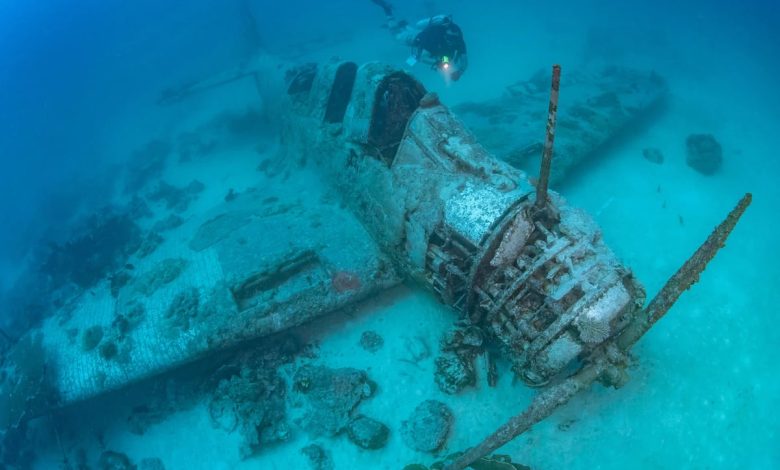
The consortium is working to recover Bureau Number 1515, a Devastator that has remained in the waters off Jaluit Atoll in the Marshall Islands for more than 80 years.
The three-seat, all-metal monoplane with hydraulic folding wings and semiretractable landing gear brought the monoplane era to U.S. carrier aviation. The Devastator, according to historian Barrett Tillman, “was a generational jump for naval aviation, and squadrons often struggled to master ‘all these new gadgets’ that were previously unknown.”
Retractable wheels and power-folding wings, in particular, gave the Devastator a foreboding nickname in the fleet — “suicide coffins.”
Despite this moniker, the Devastator played a key role in the opening salvos of the Pacific campaign — including the battles of the Coral Sea and Midway — as the United States found its footing in the wake of Pearl Harbor.
According to the Naval History and Heritage Command, during the early phase of the Pacific War, Bureau Number 1515 participated in the first of a series of hit-and-run raids on far-flung Japanese bases. Launched from the USS Yorktown (CV-5) as part of Torpedo Squadron Five, the Devastator was part of an air and shore bombardment dubbed the Marshall-Gilberts raids.
During the raid, the crew was forced to ditch the plane in the Jaluit lagoon Feb. 1, 1942. While all three naval aviators — Herbert Hein, Jr., Joseph Strahl and Marshal “Windy” Windham — survived the emergency water landing, they endured nearly three years in Japanese prisoner of war camps until their liberation in 1945.
Their plane would remain untouched until 1997, when, at the behest of the U.S. National Park Service, it was found by scuba diver Matt Harris.
“The aircraft is intact aside from the propeller and engine cowling which is separated and located approximately 15 feet from the main body of the aircraft,” Harris reported, noting that the glass canopy was intact while the forward pilot’s window was broken. “No weapons were found — these may have already been removed.”
According to U.S. Naval Institute News, the plane has been earmarked for preservation for over 23 years, with the ultimate goal of exhibiting the bomber in the future U.S. Navy National Museum, which is under development in Washington, D.C.
If recovered and preserved, Bureau Number 1515 will be the first and possibly only combat TBD-1 Devastator to ever be preserved.
After Midway the remaining 39 from the original 129 Devastators were withdrawn from fleet service, quickly replaced by TBF-1 Avengers. The Devastators went to training and utility units or became instructional platforms. The last were scrapped in 1944, according to Tillman.
“For generations to come,” writes the Naval History and Heritage Command, “the recovered Jaluit Devastator will help illustrate the early history of U.S. naval aviation and to serve as a lasting tribute to the service and sacrifice of U.S. Navy aviators during World War II, as well as to the Department of the Navy’s commitment to honoring its service members.”
Claire Barrett is an editor and military history correspondent for Military Times. She is also a World War II researcher with an unparalleled affinity for Sir Winston Churchill and Michigan football.
Read the full article here