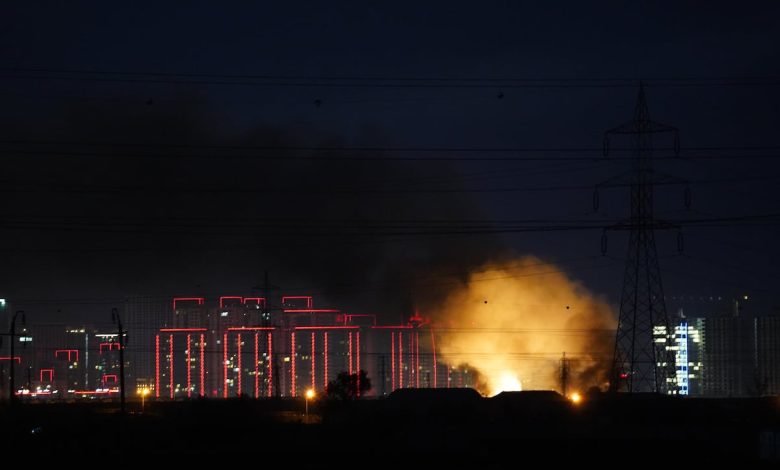

BERLIN — Iranian strikes on the weekend targeted regional bases that host European troops, triggering air defense systems and sending soldiers to seek shelter in bunkers.
“We can confirm that attacks took place yesterday and today on the multinational military bases in Erbil, Iraq, and Al Azraq, Jordan,” the Operational Command of the German Armed Forces said in a Sunday statement, adding “air defense measures” had been activated.
The German soldiers based there were relocated into air raid shelters and were unharmed, the command’s statement continued.
Other countries known to have recently been based in Erbil include Norway, Sweden, Italy, France, Hungary and the Netherlands, though some troops were relocated ahead of the U.S.-Israeli strikes on Iran.
In their initial statements, European nations were emphatic that they did not participate in the U.S.-Israeli strikes on Iran, although they simultaneously did not downplay their dislike for the Iranian regime.
The first European Union statement on Saturday reiterated that the Union was opposed to Iran’s “murderous regime” and had placed sanctions on the Iranian Revolutionary Guards Corps, which the EU also recently designated a terrorist organization. The EU called for “maximum restraint” and stressed the importance of nonproliferation and its longstanding preference for a diplomatic resolution of the crisis.
“For regional security and stability, it is of the utmost importance that there is no further escalation through Iran’s unjustified attacks on partners in the region,” Ursula von der Leyen, the EU Commission’s president, said on X, formerly Twitter. She scheduled a high-level meeting to discuss the situation for Monday, two days after the initial attacks.
Although European nations were not involved in the initial strikes on Iran, their direct involvement in the crisis remains possible, given that European assets and missions are scattered across the region.
The EU’s Operation Aspides naval mission, which protects shipping in the Red Sea against strikes from Houthi rebels in Yemen, was extended for another year last week, and is set to receive a reinforcement of two French warships, bringing the total to five. The mission’s mandate was due to expire on Feb. 28, the day that the regional war began.
On Monday morning, news broke that an Iranian drone had struck the British Royal Air Force base Akrotiri on the island of Cyprus, per The Guardian. This came just hours after the U.K. government had decided to grant U.S. forces access to its bases for strikes on Iran. No casualties and only “limited” damage were reported. The two large military base areas in the south of Cyprus − Akrotiri and Dhekelia − are considered sovereign British overseas territories.
Meanwhile, the French foreign ministry on Monday rejected chatter on X that the Charles de Gaulle aircraft carrier was being sent to the Eastern Mediterranean.
European governments estimate that tens of thousands of their citizens are in the region, also owing to the United Arab Emirates’ popularity as a destination, residence and stopover location. Spain and Germany each estimate over 30,000 of their citizens are currently in the Middle East.
Linus Höller is Defense News’ Europe correspondent and OSINT investigator. He reports on the arms deals, sanctions, and geopolitics shaping Europe and the world. He holds a master’s degrees in WMD nonproliferation, terrorism studies, and international relations, and works in four languages: English, German, Russian, and Spanish.
Read the full article here