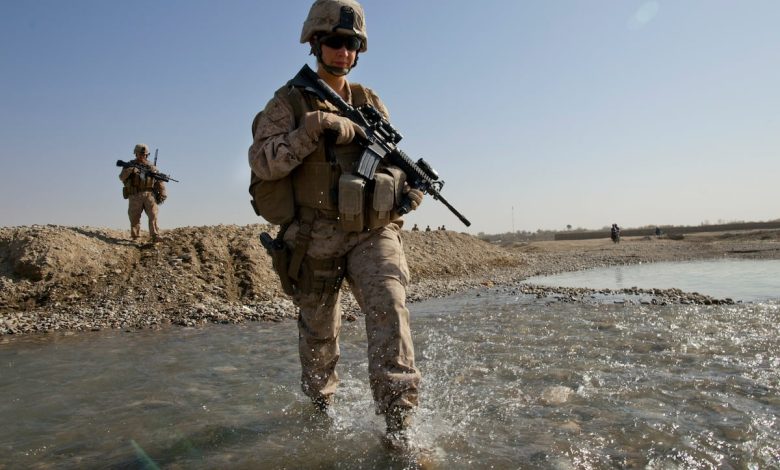

This much we know: at least 154 women have earned the vaunted black-and-gold Ranger tab, according to U.S. Army data from early 2025.
Ranger School is designed to push soldiers to their limits. It demands peak performance while sleep deprived and hungry. A swim test conducted in full uniform. A five-mile run in no more than 40 minutes. A 12-mile foot march lugging a 35-pound rucksack. And that’s just the preliminary phase.
For much of its history, it stood as the Army’s most grueling test of physical and mental prowess — reserved exclusively for men.
That changed in 2015 when the Department of Defense opened Ranger School, and all combat jobs, to women. The decision was the catalyst for a groundbreaking transformation of the American military.
Now, more than a decade later, the Pentagon has launched a formal review of the “effectiveness” of the shift, resurrecting a debate many service women thought had been settled years ago.
The Pentagon, in a statement to Military Times, said the study is intended to ensure the military can meet the most rigorous demands. The statement added that Defense Secretary Pete Hegseth “will not compromise standards to satisfy quotas or an ideological agenda – that is common sense.”
But critics contend women have already proven they can successfully fill elite combat roles, pointing to the 4,594 female soldiers who are currently deployed in the Army’s conventional combat units — a count based on data independently collected by Women in the Service Coalition. The Pentagon declined to comment on the numbers.
There’s a bigger and more visceral issue, too. Women suspect the review has been launched merely to buttress a predetermined conclusion: that they do not belong in the infantry.
“The only reason to conduct a new study is if you want a different outcome and you’re prepared to skew whatever answers you get to achieve that outcome,” said Sue Fulton, executive director of Women in the Service Coalition, in an interview with Military Times. “We have every reason to believe the intent is to marginalize women because Hegseth has said so in the past.”
Hegseth, before assuming his role as defense secretary, was an outspoken critic of allowing female service members to serve in frontline combat roles.
“I’m straight up just saying we should not have women in combat roles,” he said in a podcast appearance in November 2024, citing a Marine Corps report that found all-male units outperformed mixed gender ones during a 2015 infantry integration test. “It hasn’t made us more effective. Hasn’t made us more lethal. Has made fighting more complicated.”
A study released five years later determined that the Marine Corps remained an outlier compared to other branches, with women representing the smallest share of its forces.
Hegseth walked back his stance during his confirmation hearing, insisting to lawmakers, “if we have the right standard and women meet that standard, roger, let’s go.”
Hegseth set alarm bells ringing again among some female troops last September, however. In a high-profile, fiery speech at Quantico, Virginia, he said that “every requirement” for combat troops would revert to “the highest male standard only.”
Two women who graduated from Ranger School and served in combat — both of whom requested that their last names be withheld out of fear of repercussion for speaking out — told Military Times the review stands in contrast with the meritocratic ethos the institution prides itself on.
“It is a slap in the face to all the accomplishments of the women who have been in the infantry, have been in combat arms and have contributed at such a high level,” Emily said.
“The message feels very clear: According to leadership, the women in combat arms achieved their success because the standards were lowered for them. But the standards were never lowered for us. I took the same physical fitness test as the men at Ranger School. We earned our spots,” she added.
After the Pentagon opened all jobs in combat to women, the Army introduced gender-neutral physical tests. Hegseth expanded that framework in 2025 to encompass all combat arms positions.
Olivia, who has deployed to multiple war zones as a field artillery officer, told Military Times the debate feels abstract when set against the realities of the battlefield.
“Combat is an equalizer,” she asserted. “When people are shooting at you or you’re taking incoming rocket attacks, all those kinds of divisions disappear.
“This is an American soldier,” she continued. “It doesn’t matter where you come from, who you are, if you’re a man or a woman. It matters that we are all a part of the same fighting force and we all have the same goal in mind. You better fucking step up.”
She concluded that her experience in Ranger School was egalitarian.
“The standard has always been the same,” she said. “Anyone who has been there would know that.”
Tanya Noury is a reporter for Military Times and Defense News, with coverage focusing on the White House and Pentagon.
Read the full article here