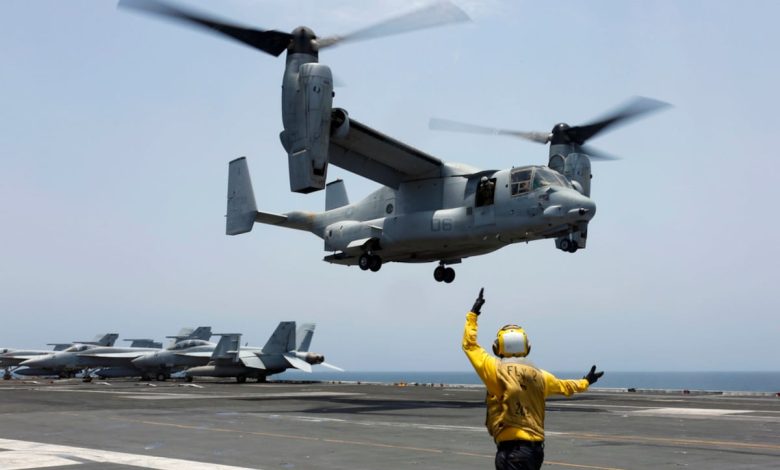

The Defense Department should improve information sharing among different services and offices to improve the V-22 Osprey tiltrotor aircraft’s safety and reduce dangerous or fatal accidents, the Government Accountability Office said Friday.
In its report, “Osprey Aircraft: Additional Oversight and Information Sharing Would Improve Safety Efforts,” the GAO said Osprey program stakeholders — including its Joint Program Office and the services that fly it — have not routinely shared information on important areas, including hazard and accident reporting, aircraft knowledge and emergency procedures, and maintenance data on parts and components commonly used across the different types of V-22.
As a result, known problems with the Osprey have remained unresolved for years and in some cases at least a decade, the GAO said.
Without setting an oversight structure that clearly defines roles and responsibilities for fixing the Osprey’s known safety risks, the report said, the Pentagon cannot be sure those problems will be fully resolved.
The Marine Corps, Air Force and Navy have a fleet of more than 400 Ospreys, which can take off and land like a helicopter, and then switch to forward flight like an airplane. This makes them ideally suited to take off and land from aircraft carriers, as well as for transporting special operations forces to and from austere environments where typical runways may not exist.
The aircraft has had above-average accident rates over the years, and some high-profile and tragic crashes that killed service members.
The GAO said the Marine Corps and Air Force rates of serious accidents in the Osprey over the last decade was, in nearly all years, higher than the services’ overall fixed-wing and rotary-wing accident rates.
That included four fatal accidents since 2022 that killed 20 service members, according to the report. The GAO said the Marine Corps and Air Force both saw serious accident rates in their Osprey variants rise in 2023 and 2024. Serious accidents are class A and B mishaps that result in death, permanent disability, extensive hospitalization, at least $600,000 in property damage or a destroyed aircraft.
Between 2015 and 2024, the only year serious Osprey accident rates were lower than average was in 2019, and even then only for the Marine Corps, the GAO said.
Most serious Osprey accidents were reportedly caused by airframe or engine component failure, or human error during flight or maintenance, according to the report. Materiel failures included problems with the Osprey’s proprotor gearbox clutches, which lead to lurching “hard clutch engagements” and could endanger flights, as well as vibration and chipping in the gearboxes and erosion of rotor blades.
The GAO said accident investigators concluded that in two of the four recent fatal Osprey accidents, a combined hard clutch engagement and catastrophic failure of proprotor gearbox components were factors.
Some Ospreys have also had problems with their engines rapidly losing or surging power during reduced visibility landings when flying over sand and dust.
In one instance, a Marine Corps Osprey crashed in Hawaii during a May 2015 training flight after sand was sucked into one of its engines while landing, causing the engine to stall. Two Marines died in that crash, and another 20 were injured.
But the GAO said the stakeholders charged with running the Osprey program, including the V-22 Joint Program Office and military services that fly them, have not fully identified or analyzed those problems, or responded with solutions to fix those procedural or materiel safety issues. The services and Osprey JPO had closed 45 risk assessments at the time of the GAO’s review, but 34 remained open, including eight serious — and potentially catastrophic — risks that had been open for a median period of 10 years.
Another 18 risks were deemed medium, and either potentially catastrophic or critical, and had been open for a median duration of nearly nine years, according to the report.
The GAO recommended that the defense secretary ensure the Navy and Air Force secretaries, along with the top generals in the Marine Corps, Air Force, Navy and Air Force Special Operations Command, work together to improve the joint Osprey program’s process for identifying, analyzing and responding to all safety risks.
This should include creating an oversight structure that clearly defines roles and responsibilities for resolving safety risks promptly and periodically reviewing efforts to fix them, the GAO said.
The GAO also recommended those top officials establish a routine system, such as a regularly occurring multiservice conference, to share information on the Osprey and emergency procedures. And the officials should conduct a comprehensive review of maintenance guidance and inspection procedures and update them as needed so Osprey units are using a system to track aircraft components, the GAO said.
The Pentagon agreed with the GAO’s recommendations and said it would take action to incorporate them into its Osprey policies and procedures.
Stephen Losey is the air warfare reporter for Defense News. He previously covered leadership and personnel issues at Air Force Times, and the Pentagon, special operations and air warfare at Military.com. He has traveled to the Middle East to cover U.S. Air Force operations.
Read the full article here