
Amid a review commissioned by Navy Secretary John Phelan, the Navy will be cutting back the number of mandatory uniforms issued to sailors, the service’s director of Military Personnel Plans and Policy said.
In an exclusive interview with Military Times, Rear Adm. Jennifer Couture said the Navy would finally make a long-anticipated cutback to one PT uniform by next year and soon announce other seabag reductions as well.
“By 2027, it will be one PT uniform,” Couture said. “That makes sense. And it is also higher-quality. It is more in line with, if you were to go to a running store out in town … the kinds of clothing you would find there.“
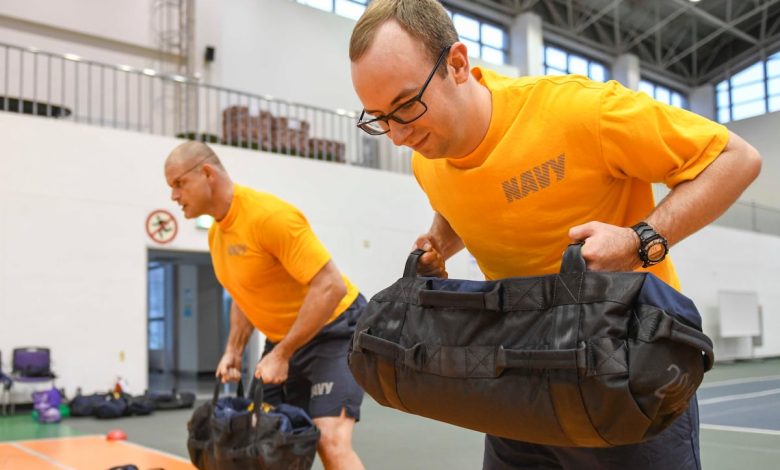
The Navy in 2019 introduced a new PT uniform consisting of a moisture-wicking navy-blue short-sleeved shirt emblazoned with gold Navy logos and matching shorts with a 5-inch inseam and side pocket. At the time, officials said the much older PT set with its bright-yellow cotton T-shirt would eventually be phased out. But until now, no timeline has been provided for the shift.
Also being considered for elimination are some of the working boot options available to sailors, Couture said. A slide presentation posted on the Navy’s HR website last year listed nine different categories of authorized general-purpose, safety and flight deck boots. The most recent option is the I-Boot 5 for working uniforms, introduced in 2022. Along with six uniforms, the seabag sailors receive at boot camp includes two pairs of boots.
“We have lots and lots of different kinds of boots,” Couture said. “If you see 10 sailors in a room, there might be, you know, eight different pairs of boots on people. And so we’ve said, why are we doing this? Does this really make sense? Does this meet the requirement for their working conditions?”
The same simplifying logic is being applied to dress uniforms, Couture said. Navy dress uniforms fall into three categories: service dress, the most commonly used; ceremonial; and dinner dress, for more rare and formal occasions. For enlisted women, there are four different styles of dinner dress uniforms, all with lists of prescribed and optional accessories.
“Do we have too many dress uniforms,” Couture said, “And [are we] making that less burdensome on people?”
It was to address these questions in a consistent and ongoing way, she said, that the Navy reestablished its dormant uniform board in May 2025 — a panel headed by the chief of Naval Personnel and including master chief petty officers from around the fleet to represent sailors. Other voting members include the chief of Navy Reserve, type commanders and the master chief petty officer of the Navy. The board is set to meet twice a year, in April and October, to review recommendations and vote on changes.
“The Navy Uniform Board will provide a transparent, Navy-wide forum to review Fleet-recommended uniform policies and requirements with the goals of improving or clarifying standards,” a message to the force in May stated. “Additionally, the Navy Uniform Board will review and make recommendations on planned or proposed uniform related research, development, testing, and evaluation projects to include organizational clothing. The uniform board will be guided by the uniform goals and policy direction established by the Secretary of the Navy and the chief of Naval Operations.”
Couture said the newly reestablished board had been meeting more frequently than prescribed — about once a month — to address “some really important things that we want to take care of with speed” but emphasized that sailors should raise their own uniform concerns and recommendations to their fleet and force master chiefs for future consideration.
One urgent uniform priority Couture cited was achieving a proper fit for women’s uniforms. When she was a midshipman in the Reserve Officer Training Corps program at George Washington University in 1995, she said, women were still wearing the flight attendant-reminiscent uniforms the WAVES of World War II had sported. And while many updates have taken place in the decades since then, there’s much still to do. In one example, she mentioned her dress blue uniform trousers, which had pockets that barely fit an identification card. That design, based on the assumption that female sailors would carry a purse, was out of date, she said.
“We owe our sailors, all of our sailors, better functionality, form and fit for the uniforms,” she said.
Sailors should expect more announcements about what’s in and out of the uniform seabag, Couture said, in the next few months.
Hope Hodge Seck is an award-winning investigative and enterprise reporter covering the U.S. military and national defense. The former managing editor of Military.com, her work has also appeared in the Washington Post, Politico Magazine, USA Today and Popular Mechanics.
Read the full article here