
Since its introduction in World War II by the German army, which used six-barreled Nebelwerfer rocket launchers on the Eastern Front to vaporize their enemies and obstacles, nations such as the United States, Russia and now, reportedly, Israel have utilized the deadly capabilities of thermobaric munitions.
The early iteration by the Germans, which saw the first five rounds of the launcher carrying gas and the sixth a detonating round, have progressed into devastatingly lethal weapons that are capable of “detonating the air.”
Modern thermobaric weaponry evolved from the jungles of Vietnam, where the U.S. Army and Air Force utilized the BLU-82 “daisy cutter,” a 15,000-pound munition used to carve out helicopter landing zones amid dense foliage.
Following the 9/11 attacks on New York City and the Pentagon, the U.S. has deployed several BLU-82 air-blast bombs — a smaller Massive Ordnance Air Blast Bomb predecessor — during the early days of fighting the Taliban and al-Qaida, including the December 2001 Battle of Tora Bora, according to Scientific American.
The Marine Corps also deployed a Shoulder Mounted Assault Weapon with a “novel explosive”— containing a thermobaric mixture — during the 2005 Battle of Fallujah to devastating effect. In 2017, the U.S. military dropped the GBU-43/B MOAB aka the “Mother of all Bombs,” targeting a network of tunnels operated by the Islamic State affiliate in Afghanistan, or ISIS-K.
“This is a tough munition to use,” A.J. Clark, a former Air Force intelligence analyst and president of Thermopylae Sciences + Technology, told Scientific American. “It might make sense if there’s a concentration of enemy troops but it’s not something you want to use when you have friendlies or civilians in the vicinity. There’s no way to control it.”
How it works
Thermobaric weapons, often erroneously referred to as vacuum or aerosol bombs, work by initially dispersing an aerosol cloud of gas, liquid or finely powdered explosive, according to the Journal of Military and Veterans’ Health.
This cloud then flows around objects and into the cavities and structures of buildings, bunkers and engine bays of armored vehicles before igniting. The subsequent plasma cloud is capable of reaching 6,332 degrees Fahrenheit, vaporizing anything in its path.
The overpressure from a thermobaric detonation contains a longer than normal blast time, roughly 1,000 pounds per square inch, then reflects back and forth, submitting the target to “multiple insults,” according to the journal. (For context, normal atmospheric pressure is 14.7 pounds per square inch.)
“It just blows your lungs out of your mouth. It kind of turns you inside out,” Edward Priest, a former Air Force Special Operations combat controller, told Scientific American in less scientific but equally graphic terms.
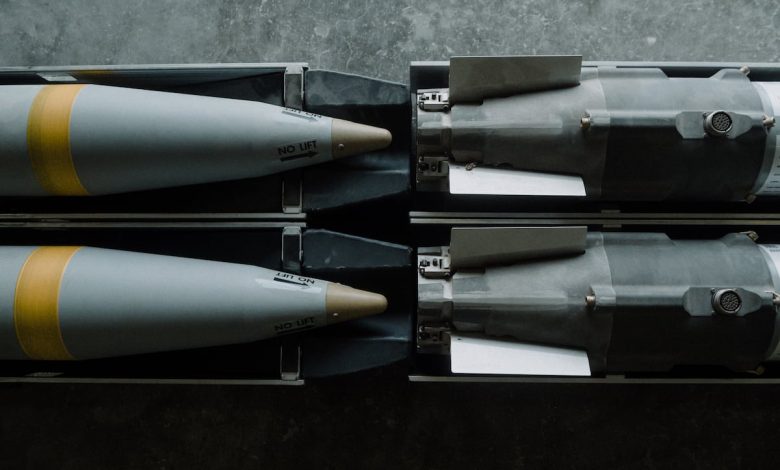
Thermobaric weapons, according to the Red Cross, can take a variety of lethal forms: bombs; hand grenades; projectiles (mortar or artillery shells); and warheads that are integrated with existing delivery systems such as shoulder-launched or multiple-barrel mobile rocket launchers, air-delivered laser-guided bombs, or ground- or air-launched guided or unguided missiles.
New age of weaponry
Thermobaric weapons have been used by Russia in Chechnya in the 1990s, reportedly against China during a 1969 border conflict and most recently, in the conflict in Syria and possibly by the Syrian regime itself, the Center for Arms Control and Non-Proliferation reports.
Since 2022, Russia has been accused of utilizing thermal weaponry in their war against Ukraine and, most recently, the Israel has allegedly used American-made thermobaric munitions in Gaza.
A Feb. 10 Al Jazeera article claims that since the war began in October 2023 teams in Gaza have documented 2,842 Palestinians who have been “evaporated … leaving behind no remains other than blood spray or small fragments of flesh.”
Data compiled by Gaza’s Civil Defense teams since October 2023 identified specific U.S.-manufactured munitions linked to these types of attacks, including the MK-84 ‘Hammer,’ the BLU-109 bunker buster and the GBU-39.
On Tuesday, former Congresswoman Marjorie Taylor Greene reacted on X to the investigation regarding the alleged use of thermal and thermobaric weapons in Gaza, writing, “If this is true and our country supplied the weapons, these are horrific war crimes. Crimes against humanity. And our country provided such weapons? When? Most Americans do not want to pay for this or be involved in such weapons.”
While there are no international laws specifically banning the use of the munitions, if a nation uses them against a civilian populations in built-up areas, schools or hospitals, then it could conceivably be convicted of a war crime under the Hague Conventions of 1899 and 1907.
Claire Barrett is an editor and military history correspondent for Military Times. She is also a World War II researcher with an unparalleled affinity for Sir Winston Churchill and Michigan football.
Read the full article here