
The U.S. is sending more reinforcements to the Middle East in support of the Iran war.
U.S. Defense Secretary Pete Hegseth reportedly approved a request from U.S. Central Command for an element of an amphibious ready group and attached Marine Expeditionary Unit to help combat Iran’s regional attacks, the Wall Street Journal first reported Friday.
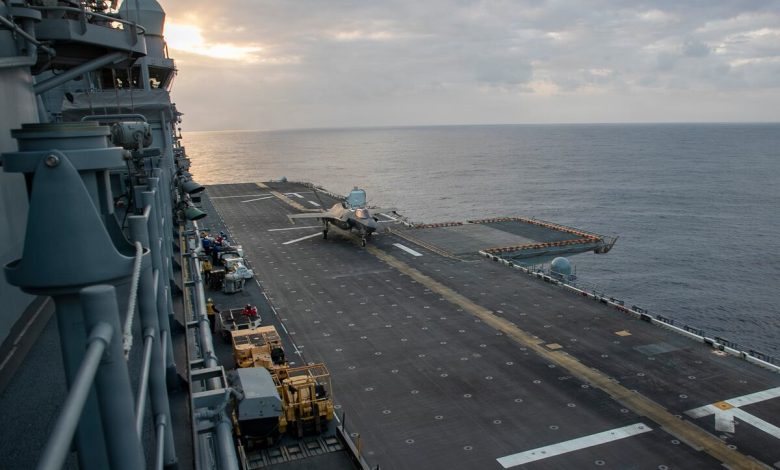
The supplemental forces would include up to 5,000 personnel and several warships, including the USS Tripoli, which is on its way to the Middle East from its homeport in Sasebo, Japan, the report said.
The Tripoli Amphibious Ready Group includes the America-class amphibious assault ship USS Tripoli, the San Antonio-class amphibious transport dock ships USS New Orleans and USS San Diego and the embarked 31st Marine Expeditionary Unit.
The 31st MEU, meanwhile, includes a ground combat element, which features a battalion landing team — an infantry battalion and combat support elements — of around 1,100 Marines and sailors.
Also included is the aviation combat element, which features tiltrotor and fixed-wing aircraft, transport and attack helicopters, ground support assets and air defense teams.
A combat logistics battalion with equipment and personnel capable of sustaining a MEU in austere environments for up to 15 days will also join the effort. This group includes medical, supply and explosive ordnance personnel, among others.
Requests for comment from the Pentagon and CENTCOM were not returned as of press time. The Navy told Military Times it would not be commenting.
The deployment of the Tripoli Amphibious Ready Group comes less than a year after a Military Times report found the readiness rate of the Navy’s amphibious assault ships had dropped to just 41% amid the Trump administration’s ramped-up effort to combat drug cartels in Latin America and the Caribbean.
The readiness issue at the time resulted in a more than five-month gap in MEU deployments.
Despite any strain, the U.S. continues to ramp up attacks on the Islamic Republic.
CENTCOM on Thursday said that American forces have struck roughly 6,000 targets inside Iran since the war began. More than 60 Iranian ships and over 30 minelayers have also been eliminated, CENTCOM announced.
Pentagon officials told senators in a classified briefing this week that the first six days of Operation Epic Fury cost American taxpayers an estimated $11.3 billion, according to a person familiar with the session.
The figure, however, omitted a range of war-related expenses, indicating the overall total is likely to rise.
An incident Thursday saw U.S. deaths in the Iran war nearly double after a U.S. Air Force KC-135 refueling aircraft crashed during ongoing combat operations.
All six crew members were killed in the crash, which was not caused by hostile or friendly fire, CENTCOM confirmed Friday. Two aircraft were reportedly involved in the incident, officials said, with the second aircraft landing safely.
A total of 13 U.S. service members have been killed during combat actions and roughly 140 more wounded — eight severely — across the opening two weeks of Operation Epic Fury.
Riley Ceder is a reporter at Military Times, where he covers breaking news, criminal justice, investigations, and cyber. He previously worked as an investigative practicum student at The Washington Post, where he contributed to the Abused by the Badge investigation.
J.D. Simkins is Editor-in-Chief of Military Times and Defense News, and a Marine Corps veteran of the Iraq War.
Read the full article here