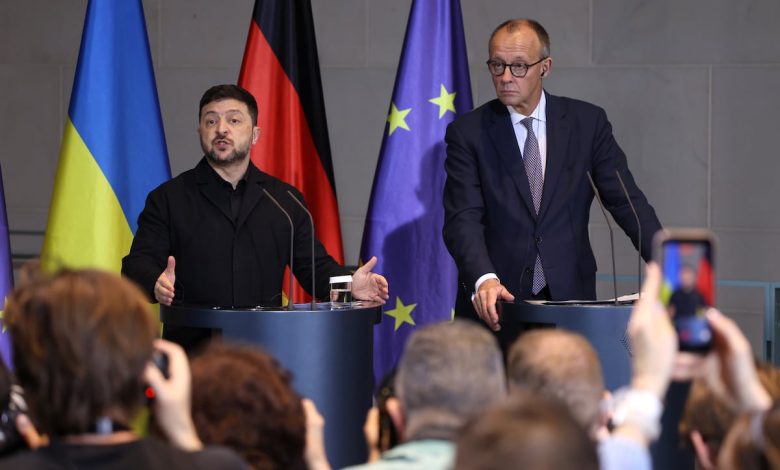

BERLIN — Ukrainian, European and U.S. negotiators have wrapped up two days of talks here with what officials describe as the most substantial movement yet toward a political framework to end Russia’s full‑scale invasion, even as core territorial questions remain unresolved.
Meanwhile, Ukraine on Tuesday predicted the total costs for its defense at $120 billion for 2026, of which half would have to come from foreign support.
According to Zelenskyy and Ukrainian officials, the discussions in Berlin focused on a package of five documents that would underpin an eventual peace deal, several of which are dedicated to long‑term security guarantees for Ukraine. Kyiv says parts of the package are intended to be legally binding, with an “Article 5-like” mutual‑defense commitment, a reference to NATO nomenclature, requiring U.S. congressional approval and backed by additional European pledges.
German officials describe Washington’s offer on legal and material guarantees as “truly remarkable” and a “very important step forward.” The conference marks the first major EU‑hosted attempt to shape the emerging security architecture around a potential ceasefire.
Europe, the U.S. and Ukraine “achieved a common sense of purpose” on Monday in their quest to end the war in Ukraine, German Defense Minister Boris Pistorius said during his opening remarks for the Ukraine Defense Contact Group on Tuesday. There had previously been significant differences between Europe and the U.S. regarding a peace plan proposed by Washington, which was perceived across the Atlantic as a capitulation to most of Moscow’s war aims.
The center of gravity has shifted toward Europe in the past months, as the continent is now single-handedly financing Ukraine’s continued defense against Russia following Washington’s suspension of military assistance since March 2025. Total European allocated aid since the start of Russia’s invasion now more than doubles U.S. support for Ukraine, according to the Kiel Institute, a Germany-based research organization.
Besides progress on security guarantees, negotiators reported no tangible advance on the question of territorial concessions.
Russian demands for formal recognition of its hold over parts of eastern Ukraine remain incompatible with Kyiv’s public position, and Berlin officials describe the road ahead on these questions as “very long.”
Ukrainian government officials have repeatedly stressed that suggestions of ceding Ukrainian-held territory remain off the table and that any deal must avoid freezing the conflict on terms favorable to Moscow. European leaders have said only Ukrainians can decide on a path forward in territorial questions, despite U.S. pressure in recent weeks for Kyiv to give up about a fifth of its land to Russia.
Zelenskyy has signaled that once the five‑document package is finalized with U.S. and European partners, Kyiv expects a direct meeting with President Donald Trump to test whether Moscow will accept the emerging framework.
European and U.S. officials alike are portraying the Berlin talks as “very positive,” saying there is consensus on key issues even if the outcome stopped short of a formal ceasefire proposal.
A European-led multinational peacekeeping force to be deployed in Ukraine once the war ends is a key pillar of the proposed deal.
On Tuesday, British Defence Minister John Healey reaffirmed his country’s commitment to such a mission, saying that London continues “to direct funding to prepare our U.K. troops and armed forces so that we are ready to deploy when peace comes, with troops on the ground and jets in the air.”
Ten European leaders, along with EU Commission President Ursula von der Leyen, issued a joint statement after the talks proposing a “multinational force for Ukraine” led by Europe and backed by the United States. The European proposal additionally called for “sustained and significant support to Ukraine to build its armed forces, which should remain at a peacetime level of 800,000.”
In the meantime, Ukraine will be reliant on support from its Western partners. Speaking at the Ukraine Defense Contact Group meeting on Tuesday, Denys Shmyhal, the Ukrainian minister of defense, said his country expected the war costs to total $120 billion next year, of which Ukraine would be able to cover half on its own.
“The remaining $60 billion must come from our partners,” Shmyhal said, asking the countries present to each allocate at least 0.25% of their 2026 economic power to Ukraine’s defensive effort. Air defense remains a priority, according to the defense minister.
“Strong and coordinated decisions will accelerate our path toward a just and lasting peace,” Shmyhal said. “Now is the moment to bring it closer.”
Linus Höller is Defense News’ Europe correspondent and OSINT investigator. He reports on the arms deals, sanctions, and geopolitics shaping Europe and the world. He holds a master’s degrees in WMD nonproliferation, terrorism studies, and international relations, and works in four languages: English, German, Russian, and Spanish.
Read the full article here