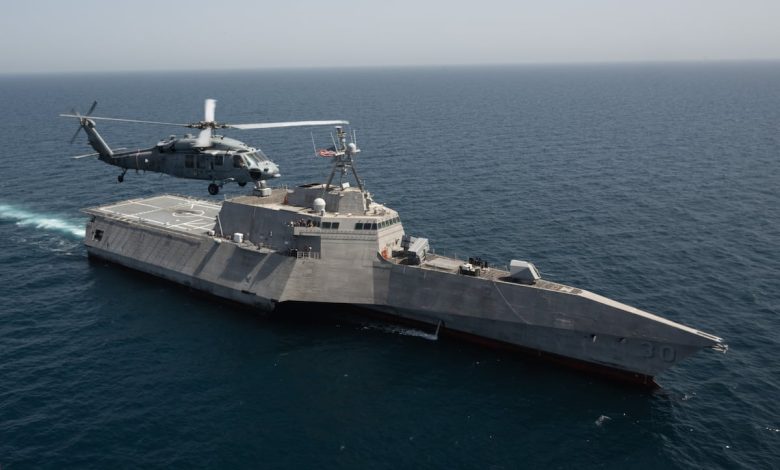

U.S. Navy counter-mine ships that replaced minesweepers last year in Bahrain have yet to demonstrate their reliability and effectiveness in the face of potential naval mine warfare, according to the Defense Department’s testing office and military experts.
The Pentagon was unable to determine the operational effectiveness or suitability of Independence-class littoral combat ships equipped with the mine countermeasures mission package due to insufficient data on its mine-hunting and mine-destroying technology, according to the Office of the Director, Operational Test & Evaluation’s fiscal 2025 annual report.
Several retired U.S. Navy captains who deployed on minesweepers and defense analysts also told Military Times that the LCS with the MCM mission package, which replaced four Avenger-class mine countermeasures ships in 2025, is not as effective as its predecessor due to a myriad of technological constraints and malfunctions.
“The Navy has not provided sufficient data from operational employment of [Airborne Mine Neutralization System] and [Airborne Laser Mine Detection System] to determine operational effectiveness of the Independence variant with MCM MP,” the March 13 DOT&E report stated.
Both of these counter-mine systems are deployed by MH-60S helicopters, which are attached to the littoral combat ship. They identify and destroys mines through sonar, lasers and deployed unmanned underwater vehicles.
The systems “demonstrated low reliability prior to fleet release,” according to a classified 2016 DOT&E report, the March 13 report said.
“The AMNS cannot neutralize most of the mines in the Navy’s threat scenarios,” a public version of the 2016 report said.
The 2025 DOT&E report also stated that the Unmanned Influence Sweep System, which is employed onboard the LCS and uses an unmanned surface vehicle to sweep mines with acoustic and electromagnetic generators, was “not operationally suitable.”
It cited a previous 2022 DOT&E report that said the system’s operational availability was 29%, “well below the Navy-defined minimum threshold,” and did “not support sustained mine sweeping operations.”
Despite ongoing concerns with the technology, the Navy declared the MCM mission package and AN/AQS-20 Sonar Mine Detection Sets operationally capable in 2023.
The Navy conducted no additional operational tests of the LCS with the MCM mission package in fiscal 2025, according to DOT&E’s report.
The service did not return Military Times’ request for comment by the time of this story’s publication.
An unproven system
“I’m a pessimist when it comes to our ability to deal with the mine warfare threat,” said retired Capt. Anthony Cowden.
Cowden spent one year assigned to a minesweeper during his 37-year career as a commissioned naval officer and said he didn’t believe that the LCS with the MCM mission package could prove as effective as the Avenger-class mine countermeasures ship.
The fact that it has never been proven in combat is a major concern for Cowden.
“The question is, it can reach [initial operation capability], but if it can only sweep 10% as effectively as the old capability, that doesn’t mean you’re not at IOC, it just means you’ve got a real problem,” Cowden said.
The Navy still has four Avenger-class mine countermeasures ships stationed in Sasebo, Japan, but decommissioned the four that were homeported in Bahrain in 2025 — USS Devastator, USS Dextrous, USS Gladiator and USS Sentry — each of which served for over 30 years.
The minesweepers have a proven track record of identifying and destroying naval mines, using their sonar, tethered remote operating systems and influence technology to sweep over 1,000 mines off the coast of Kuwait during the Gulf War.
RELATED
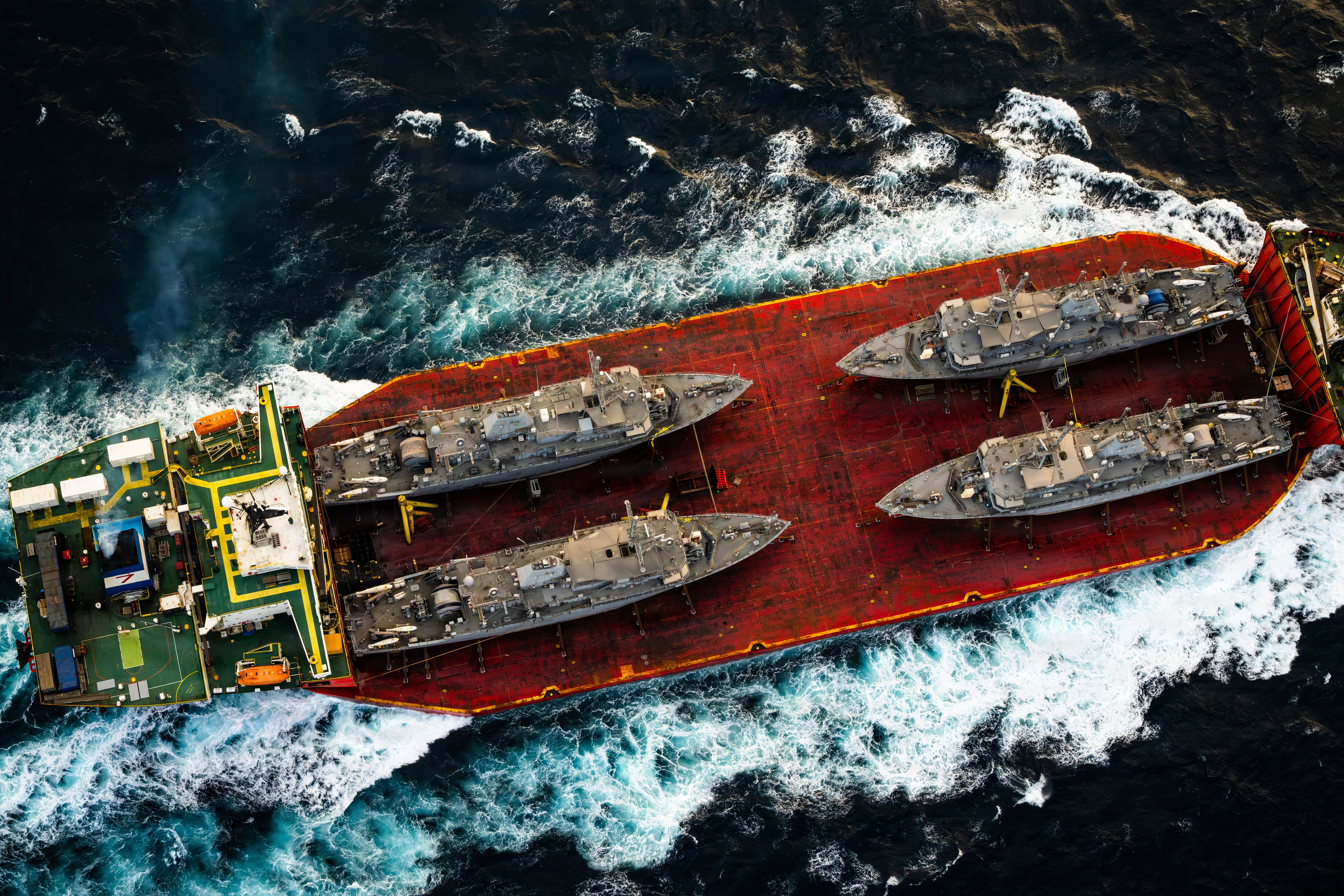
Three littoral combat ships with the MCM mission package arrived in the Middle East in 2025, including the USS Canberra, USS Santa Barbara and USS Tulsa.
The Canberra was stationed in the Indian Ocean as of March 16, and the Santa Barbara and Tulsa were conducting a port call in Singapore as of Thursday.
Minesweepers are made of wood and encased in fiberglass, which allows them to operate inside and near a mine-threat zone. The LCS with the MCM mission package, however, is made of aluminum and must sit outside the mine zone as it deploys helicopters and unmanned underwater and surface vehicles to mine hunt and minesweep.
This standoff distance, coupled with the littoral combat ship’s reliance on unproven autonomous systems to hunt and sweep mines, worries Cowden.
Capt. Sam Howard, who commanded the USS Raven minesweeper during his time in the Navy, said the point of the new MCM mission package was to keep service members outside of the mine field and protect them from danger.
But that doesn’t mean its efficacy rivals that of the Avenger-class minesweeper.
“They don’t have the endurance, nor has the automation arrived at the level of effectiveness that having manned systems historically has had,” Howard said.
A host of potential problems
Compared to its predecessor, the LCS with the MCM mission package has limited range.
The LCS mothership has to maintain line of sight with the unmanned surface vehicle or vessel it deploys to minesweep, which means its radius of operability is limited, since the LCS must remain outside the mine zone.
There has also been a host of other problems for the ship, which began its initial testing and evaluation in the fall of 2022 aboard the USS Cincinnati.
Ethan Connell, assistant director for George Mason University’s Taiwan Security Monitor, has written about America’s weaknesses when it comes to dealing with mine warfare for the Center of Maritime Strategy, a U.S. think tank focusing on national security in the sea domain.
He said that the MCM technology tasked with detecting mines had issues doing just that when it conducted testing off the coast of Southern California with clear water and no visibility hinderances.
The systems both detected more mines and less mines than were actually there, he said. The operability tests used threat-representative mine surrogates, which are devices meant to simulate mines.
If the ship was making these mistakes during ideal testing conditions, how would it fare in the murky waters of the Strait of Hormuz, he posited. The 2016 DTO&E report determined mine-hunting capabilities are limited in “other-than-benign environmental conditions.”
Further, the LCS with the MCM mission package has previously reported single points of failure, including: the platform lift that helps move the unmanned underwater vehicle from the mission bay to the hangar bay; the crane that places unmanned surface vehicles into the water; and the tow hook on the unmanned surface vehicles.
“There’s no backup,” Connell said.
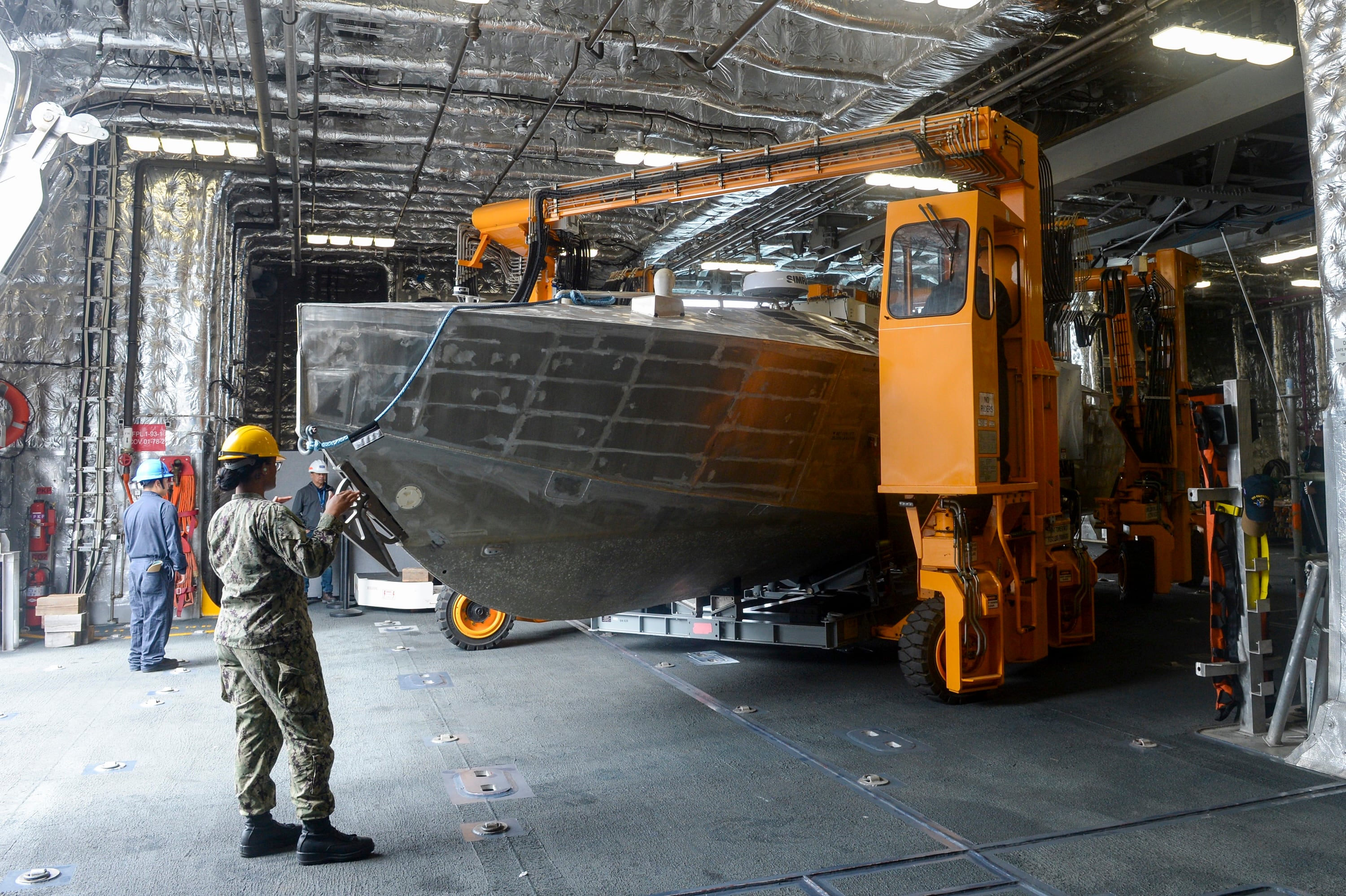
If one of these elements were to go awry, the whole MCM mission package could not function, according to Connell, especially since sailors aboard the ship likely wouldn’t be able to fix the machinery and would need assistance from the manufacturer.
“Maintainers demonstrated limited capability to repair the [Unmanned Influence Sweep System] due to deficiencies in maintainer documentation for operational-level repairs and additional repairs that required subject matter expert intervention,” a nonpublic fiscal 2021 DOT&E report said, according to Breaking Defense.
These issues elongate the preparation time needed to deploy the autonomous aspects of the MCM mission package, Connell said. It takes four hours of premission maintenance followed by roughly 90 minutes to calibrate GPS and sonar to ensure the type of accuracy needed for MCM operations.
That’s nearly six hours that needs to be baked into planning before the mission can even begin.
“When you have a system where everything needs to be perfect in order for it to work, obviously, that is a really bad thing,” Connell said.
Even sailors tasked with the development of the technology have been candid about its status as a viable piece of technology.
Capt. Scott Hattaway, director of the Naval Surface and Mine Warfighting Development Center’s Mine Countermeasures Technical Division, hinted at its potential shortcomings in 2025.
“I’m not saying we got it right, I’m saying we’re first out of the gate,” Hattaway told Naval News.
The mine threat
The naval mine threat in the Middle East has long been noted.
Iran’s Islamic Revolutionary Guard Corps Navy views the maritime weapon as a key tenet of its military doctrine, according to a 2017 Office of Naval Intelligence report.
Iran reportedly began laying mines in the Strait of Hormuz as of March 11 and the country’s military possesses nearly 6,000 mines in its weapons stockpile, a recent report from Congress said.
Adm. Brad Cooper, head of U.S. Central Command, said March 16 that U.S. forces destroyed storage bunkers for naval mines during a March 13 U.S. strike on military targets on Iran’s oil export hub, Kharg Island.
U.S. forces destroyed 16 Iranian minelayers on March 10, according to CENTCOM.
And as of Monday, the U.S. has damaged or destroyed over 140 Iranian vessels, according to a CENTCOM fact sheet.
But Iran’s military still has ways to lay mines, according to Seth Jones, president of the defense and security department at the Center for Strategic and International Studies, a Washington think tank specializing in national security.
“The Iranians don’t have a lot of major capabilities for mine laying, but what they do have is hundreds of ships that are capable of laying two to three mines a piece, in addition to some subsurface vessels,” Jones said.
Chairman of the Joint Chiefs of Staff Gen. Dan Caine said Thursday during a Pentagon briefing that A-10 Warthogs were targeting Iran’s fast-attack watercraft in the Strait of Hormuz.
If Iran proves able to use these means to deploy mines in the sea passage, Jones said the U.S. military could potentially face challenges with its current MCM capabilities in the region, including the LCS.
If the naval mine warfare threat comes to fruition in the sea passage, the U.S. military will likely need to forward deploy its four Avenger-class mine countermeasures ships from Japan to the Middle East or ask U.S. allies with their own counter-mine capabilities for assistance, according to Jones.
The possibility of success
Others who spoke with Military Times weren’t so quick to deride the LCS with the MCM mission package.
Retired Capt. Mike Sparks, a former minesweeper commander who operated in the Persian Gulf aboard the USS Dextrous, understood the reticence to embrace the new technology.
During his time in the Middle East, in the early 2000s, there were concerns as to whether or not the minesweeper’s efforts would be successful, he said, but he and other sailors proved the ship could do its job effectively. He sees this as a sign that the LCS could do the same.
“The systems that I operated in the rivers of Iraq, were not intended to be used in the rivers of Iraq,” Sparks said.
As the Navy began rolling out the MCM mission package, his belief in the system was low and his criticism high. But his skepticism has since morphed to embrace the technology as it has advanced.
“The things that we have out there now I believe have a great deal of capability and optimally they will function as they have been designed,” Sparks said. “I expect the technology they have out there is going to succeed.”
Riley Ceder is a reporter at Military Times, where he covers breaking news, criminal justice, investigations, and cyber. He previously worked as an investigative practicum student at The Washington Post, where he contributed to the Abused by the Badge investigation.
Read the full article here