
The Defense Department’s $26.8 billion military construction request for fiscal 2027 is needed to build unaccompanied housing and protect installations to ensure the security of U.S. troops and their families in the short- and long-term, military logistics leaders said Thursday.
The budget proposal, which includes $21.5 billion for barracks across the Army, Navy, Marine Corps, Air Force and Space Force, represents a “generational investment” that addresses a backlog of construction and repair priorities, according to Dale Marks, assistant secretary of defense for energy, installations and the environment.
Marks said that the department in the past has prioritized operations over facilities and “the bill for that trade is now overdue.”
“The degraded state of our installations is no longer a future problem. It is a direct and present threat to our ability to project power, defend the homeland and properly care for our service members,” Marks said before the Senate Appropriations Subcommittee on Military Construction, Veterans Affairs and Related Agencies.
The top priority for the services is barracks improvements and construction, according to military leaders. The request follows the formation last year of a Barracks Task Force that set requirements and standards for unaccompanied housing across the services.
RELATED
The Army’s budget request includes $7 billion to “bring all rooms to new.” The service also is requesting additional funds to build new barracks at Fort Wainright, Alaska, and Joint Base San Antonio, Texas.
The Navy plans to use $2.5 billion to upgrade infrastructure to include kitchens, Wi-Fi and maintenance request systems, as well as modernize and address health and safety concerns, according to Rear Adm. Timothy Brown, deputy chief of naval operations for installations and logistics.
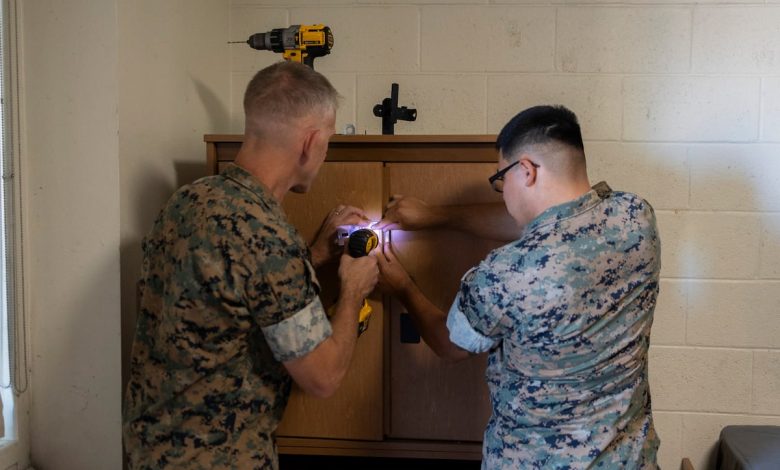
A $7 billion infusion in the Marine Corps budget would “jumpstart” the service’s barracks sustainment modernization, giving Marines “the housing that they deserve while they prepare and rehearse for potential combat operations every day,” Deputy Commandant for Installations and Logistics Lt. Gen. Stephen Sklenka said.
And the Air Force would use $330 million on top of previous funding to build unaccompanied housing — the service calls their barracks “dormitories” — at Joint Base San Antonio-Fort Sam Houston, Texas, Cannon Air Force Base, New Mexico, and Goodfellow Air Force Base, Texas.
The Barracks Task Force was created following a series of media and officials reports, including a 2023 Government Accountability Office assessment, of unsafe conditions in military barracks that included mold, inoperable fire suppression and heating and air conditioning systems and sewage overflows.
The One Big Beautiful Bill Act provided funding — nearly $1.7 billion — to restore or build new barracks, but department leaders said the funding in the military construction proposal would help continue momentum.
“We’re trying to make sure that we are getting after the problem sets using every every dollar to its max extent possible,” Marks said.
Lawmakers expressed concern for President Donald Trump’s fiscal 2027 defense budget, which requests roughly $1.1 billion through the regular congressional appropriations process and $350 billion in mandatory spending via a reconciliation effort that sidesteps routine congressional funding.
With no guarantees of success for the reconciliation strategy, priorities could go unfunded, they said.
“Reconciliation legislation is by definition uncertain, and it’s often partisan. Congress isn’t under no obligation to pass a reconciliation,” said the subcommittee’s ranking Democrat, Sen. Jon Ossoff of Georgia.
Subcommittee Chairman Sen. John Boozman, R-Ark., noted also that funding for defense projects, such as the Golden Dome missile defense program, were funded under the reconciliation dollars while construction money for some new barracks has been placed in the Facilities Sustainment, Restoration and Modernization allocation — which falls under defense appropriations, not military construction.
“Given the uncertainty surrounding reconciliation and the unpredictable nature of FSRM, I worry about whether these projects will ultimately move forward as planned,” Boozman said.
The House version of the funding bill provides $19.2 billion for military construction, $7.6 billion below the president’s budget request. The Senate has not released its initial iteration of the fiscal 2027 military construction appropriations bill.
Sklenka urged lawmakers to consider the budget carefully, especially the portions that support garrison security. With increased risks to bases at home and abroad — threats from drones, unauthorized entries by foreign nationals and cyber attacks against infrastructure — bases are under threat daily, he said.
“We all know in this room that our bases and stations are no longer the administrative garrison sanctuaries they once were. These are war fighting platforms today,” Sklenka said.
Boozman agreed.
“We have to rethink our installations … how we’re going to protect them … dealing with these incursions that … we’ve seen constantly,” he said.
Patricia Kime is a senior writer covering military and veterans health care, medicine and personnel issues.
Read the full article here