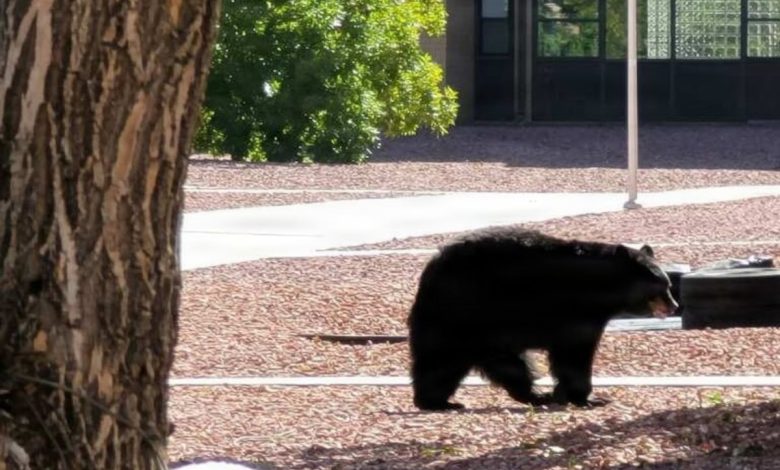

A dry winter, ravenous hunger and accessible trash have drawn bears to Fort Carson, Colorado, where officials have received 23 reported bear sightings just this year.
The real number, they believe, is likely much higher.
Capt. Robert Look Jr., chief of conservation law enforcement for Fort Carson, said low snowpack, a condition called seasonal hyperphagia — where an animal’s insatiable urge to eat overrides a natural fear of humans — and loose garbage have made conditions tempting for bears to head towards the Army post.
“Recent mild winters and low snowpack have depleted natural food sources — berries, acorns and plants — at higher mountain elevations,” Look said. “This forces hungry bears down into lower elevations, such as Fort Carson and Colorado Springs, to search for food.”
Nearby Cheyenne Mountain State Park is home to many black bears and contributes to the sightings, he said, but human behavior also makes a difference.
“Unsecured garbage, pet food left outdoors and bird feeders represent highly concentrated, easy-to-access calories for a foraging bear,” Look said, adding, “a bear’s nose is nearly 100 times more sensitive than a human’s, allowing them to detect these items from miles away.”
Most of the bears have been sighted in housing areas on the west side of Highway 115 and at the installation’s controlled access points.
Officials urged residents to remain calm and contact Fort Carson dispatch if they encounter a bear. Personnel should identify themselves to the bear by speaking in a “low and steady voice,” and use their arms — or any clothing — to make themselves seem bigger, the base said, and back away slowly. Do not try to take a selfie, the base implored.
Fort Carson also advised against running, yelling, approaching or making direct eye contact with the hungry animals, as bears can move at speeds between 30-35 miles per hour — much faster than most humans can run.
They also recommended washing trash containers with ammonia or bleach to remove or reduce the food smells that may tempt bears.
Carrying bear spray as a deterrent can also be lifesaving, and Col. Erik Oksenvaag, Fort Carson’s garrison commander, encouraged everyone to be “bear aware.”
“Parents, talk to your kids about what to do if they see a bear on post, and when in doubt, let dispatch know if you think you’ve seen one roaming around the installation,” he said in a June statement.
Fort Carson’s warning comes months after two soldiers were seriously injured in a bear attack during a land navigation exercise at Joint Base Elmendorf-Richardson. The Alaska’s Department of Fish and Game in April said the attack seemed to be “a defensive attack by a bear recently emerged from a den.”
The soldiers’ survival was attributed to the bear spray they were carrying.
Years earlier at the Alaska base, a soldier died from injuries sustained in a bear attack.
Eve Sampson is a reporter and former Army officer. She has covered conflict across the world, writing for The New York Times, The Washington Post and The Associated Press.
Read the full article here