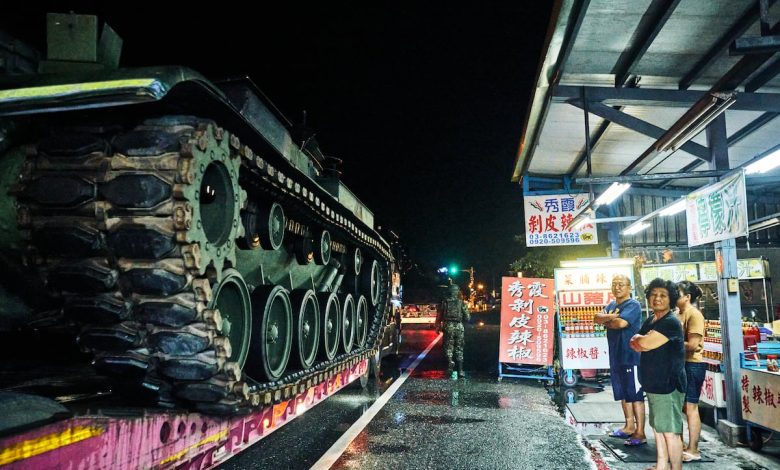

NEW TAIPEI CITY, Taiwan — Taiwan President Lai Ching-te told a forum in late September he was seeking “resilience through unity” with a new alliance that would let world officials and non-governmental groups prepare together in case of disaster.
For Taiwan, that could mean an attack or blockade by the militarily more powerful China.
Lai’s pitch to 500 experts and guests augured an international expansion of a roughly five-year-old domestic, military-civilian, whole-of-society awareness campaign similar to that seen overseas when larger countries bear down on smaller rivals.
Taiwan’s “efforts promoting whole-of-society defense resilience have progressed toward closer international connections and cooperation,” Lai said.
The domestic whole-of-society defense effort has grown visibly since its inception here, at the time when Russia was gearing up for its war in Ukraine, but where it’s going now depends who you ask.
It includes the November 2025 distribution of the cartoon-style Case of Crisis: Taiwan’s National Public Safety Guide to a targeted 9.83 million households with tips on stockpiling food and water and finding shelter.
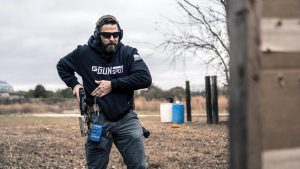
Citizens in turn have prepared “go-bags” of daily rations and basic supplies plus emergency first aid kids and civilian-led civil defense preparation courses have sprung up.
“A potential conflict involving Taiwan would not affect only military targets but also the entire population and our critical infrastructure,” said Wen Liu, Taipei-based chairperson of the non-governmental civil defense group Kuma Civil Defense Education Promotion Association.
“That means the question is not only whether Taiwan’s armed forces can defend the island,” Liu said. “It is also a question of whether Taiwanese society can continue functioning under sustained pressure.”
The association also known as the Kuma Academy launched in 2021 to train civilians in emergency preparedness and cognitive warfare awareness. Liu said it had received backing from a retired billionaire and reached 100,000 people through hundreds of in-person courses.
The whole-of-society movement was enshrined in January 2022 under ex-president Tsai Ing-wen, whose Ministry of National Defense created its All-out Defense Mobilization Agency.
Lai formed the presidential office committee two years later to bind the government and society in learning how to maintain normal operations during attacks or natural disasters. The committee meets four times annually.
Finland, Switzerland and Singapore have long practiced a whole-of-society approach, said David Silbey, a military Historian and associate teaching professor with the Cornell Brooks School of Public Policy at Cornell University.
“Finland notably [prepared] against Russia in the 1950s through 1960s, Switzerland against Germany in World War II, and civilians in Singapore who have prepared for any move from Malaysia, all smaller countries resisting bigger ones,” Silbey said.
“The goal is to deter as much as it is to win an actual conflict, as actually fighting that way would be cataclysmically destructive to the smaller country,” he said. “In Taiwan’s case, the threat obviously comes from China and they’re trying to establish and standardize a resistance model where everyone fights back against a potential invasion.”
Hospitals must stay open, food must keep reaching supermarket shelves and families still need to get around during a crisis, said Sean Su, a Taiwan-based independent political analyst.
“What [whole-of-society resilience] actually does is keep a country running while the soldiers do their thing,” Su said. “You can see that in places like Ukraine.
“Taiwan’s foundation in dealing with a crisis is our experience with typhoons and earthquakes,” he said. “But a blockade is not designed to end in a few weeks so we’ll have to adjust accordingly.”
China claims sovereignty over self-ruled Taiwan and has threatened to take the island by force, if needed. Over the past four years People’s Liberation Army forces have stepped up military exercises near Taiwan, often in the 160-kilometer (100-mile) strait between them.
The idea is “synchronizing” civilian and military responses to war or other crises, said Brian Hioe, a non-resident fellow at the Taiwan Research Hub of the University of Nottingham. The number of non-military, civil defense groups, he said, is rising – an indication that Taiwan is “serious about defense at the grassroots of society.”
But the military hasn’t embraced those civilian-led groups, Hioe said.
“The challenge to date remains how to synchronize civilian and military efforts, with the military continuing to view itself as primarily responsible for defense and taking the view that civilians should stay in their lane and leave fighting to professional soldiers,” he said.
Civilian activity has gone flat overall since the survival guides were issued, said Joanna Lei, a former legislator and current chairwoman of the National Women’s League in Taiwan. “There’s no mass hysteria, and people are living their normal lives,” she said.
Whole-of-society momentum is expected to make only a neutral or vaguely positive impact on President Donald Trump’s decision whether to approve a stalled $14 billion U.S. arms package for Taiwan, analysts say. China opposes U.S. weapons sales to the island and Trump has sought unrelated deals with Chinese President Xi Jinping at meetings in May and September.
Taiwan advocacy group the Formosan Association for Public Affairs on Sept. 28 urged Trump to approve the sale without delay, saying China’s military and maritime “gray-zone” pressure had reached “unprecedented levels.”
But Trump doesn’t “care one way or the other” about activity in Taiwan, Silbey said, because “it’s not about how serious Taiwan is for him, it’s about wooing China.”
Read the full article here