Today’s handgun buyers are spoiled for choice — to a degree that the number of options becomes almost bewildering. As a result, consumers often rely on any number of heuristics that help simplify their purchase decisions. Witness today the number of novice shooters who approach buying their first handgun as they would a pair of pants: “Will I be best served by big, medium, or small?”
Certainly, the industry terms of Full-Sized, Compact, and Subcompact are nominally meant to describe the physical dimensions of a handgun. However, there are differences between these platforms — and interesting histories — that aren’t fully explained by size alone. Let’s dig into what these categories are, and historically, how we seem to have arrived at the present moment.
The Full-Sized Handgun
For much of the history of small arms, just about any “handgun” implied a firearm of such size that it could be stowed and manipulated in ways that were far handier than that of a long gun. This made handguns a favored tool of the U.S. Cavalry, since it permitted being able to return fire while also controlling the reins of a horse. Indeed, the name “handgun” implies the use of a single hand, and up through World War II, American G.I.s were taught one-handed pistol marksmanship as a matter of course.

This is all to say that full-sized handgun would have been considered a contradiction in terms until relatively recently. As the thinking went, if one desired a truly “full-sized” firearm, they’d have likely opted for some variety of rifle or shotgun.
Today, we generally use the term “full-sized” to refer to a handgun that has been designed without too much concern for concealment — though typically, manufacturers try to make most handguns small and light enough to be comfortably carried on one’s person in some variety of holster. (And, quite truthfully, many men and women regularly conceal full-sized guns just fine with the right clothing and holster choices.)

I have nevertheless found that too many of today’s buyers tend to jump over the full-sized handgun. Novices incorrectly associate a bigger gun with additional power or unwieldiness — even when it fires the same cartridge as smaller firearms in its design family! I have seen more customers than I can count look at a firearm with a 4.5” to 5” barrel (usually, the prototypical barrel length within the category) and say, “I don’t need that much gun.”
Contrary to their expectations, the full-sized handgun offers a longer sight radius and more recoil-reducing mass. If concealed carry is not the primary consideration, I’ve found most people will be exceedingly well-served with the largest and heaviest firearm they can shoot and handle comfortably.
The Compact Handgun
Historians will note that as long as handguns have existed, so too have compact handguns. Even in the blackpowder era, gamblers and shopkeepers regularly took hacksaws to a handgun’s barrel in an effort to more easily stow it in a coat pocket or waistband, supposing the market did not already accommodate them.

As compact grew into a more defined category, things became a little more nuanced. Take a look at handgun development from the 1900s onward, especially in Europe, and one begins to see two distinct evolutionary tracks occurring. Many of the full-sized guns were designed for military use, whereas “compact” firearms were designed around the needs of police officers, whose firearms would be carried constantly but shot seldom. Compare John Browning’s M1911 and M1910, or the Czech Model 52 to the Model 50, and one will see an immediate difference in frame size.
Historically, the main drawback of a compact handgun was one of power: its scaled-down dimensions necessitated a scaled-down cartridge. Thus, while most full-sized handguns were commonly chambered for 9mm or .45 ACP, compact handguns of the twentieth century tended to be found in calibers like .380 and .32 ACP.
In the ’60s and ’70s, a new kind of “compact” handgun began to proliferate on the market: what I’ve heard many refer to as a “cut down” or “chopped” automatic. Often, these firearms would have a rebated slide or frame length — or both. A number of manufacturers realized that in many cases, shortening the gun along these two dimensions resulted in a gun that carried and concealed a little easier without losing too much by way of shootability, projectile velocity or reliability. (Within the Springfield Armory catalog, pistols like the 4.25” Ronin, Operator, etc. are excellent, modern-day examples of the type.)

Here, I would also add that legislative context aided the rise of the compact handgun. In September of 1994, Bill Clinton signed into law the “Violent Crime Control and Law Enforcement Act,” which placed a federal ban on magazines over 10 rounds. Until the legislation sunset during the George W. Bush administration, I knew a number of shooters who felt they might as well buy the compact version of a firearm, since they’d be getting the same magazine capacity even with the shorter grip. (Here in my home state of California and in other similarly restrictive states, the line of thinking persists.)
As the needle shifted towards the compact handgun, I think something became fixed in the lay consumer’s mind with respect to what a handgun “should” look like. Flanked by similar guns with a 3” and a 5” barrel, the 4” handgun appears to offer a happy medium.

Live The Armory Life. The latest content straight to your inbox plus an automatic entry to each of our monthly gun giveaways!
I will cede the point that such handguns do indeed work great for an overwhelming majority of their users. Nevertheless, I feel the “compact” category represents a compromise between shootability and concealability; as my own collection evinces, however, I’ve tended to go one way or the other as needs may dictate.
The Subcompact Handgun
As the name implies, this category of handguns is “smaller than small.” For much of the 20th century, this group comprised “mouse guns” like John Browning’s “Vest Pocket” model of 1908, the French MAB Model B, or the Astra Cub. Calibers were almost always .32 and .25 ACP, whose ballistic performances left much to be desired.

By the 1990s, however, more companies began to push the envelope by simply “chopping” the dimensions of full-sized handguns one step beyond their compact dimensions. Problem was, this often came at the expense of reliability.

Many of this breed of subcompact guns came suggested with “break-in” periods of several hundred rounds by their manufacturers, and even then required a stiff wrist and the right ammo in order to function. That’s to say nothing of the amplified recoil; in practice, only a very skilled shooter could run these handguns anywhere close to their accuracy potential. Frankly, my 3” XD-9 is the only gun of this type I own (or I’ve found that works worth a darn).
Today, subcompact firearms are of an entirely new breed, and credit Springfield Armory for laying much of the foundation. Nearly 20 years ago, the company released the first generation of its 1911 EMP. That model scaled the 1911 down and designed it specifically to provide reliable functioning with 9mm. It remains a wise choice for concealed carry.

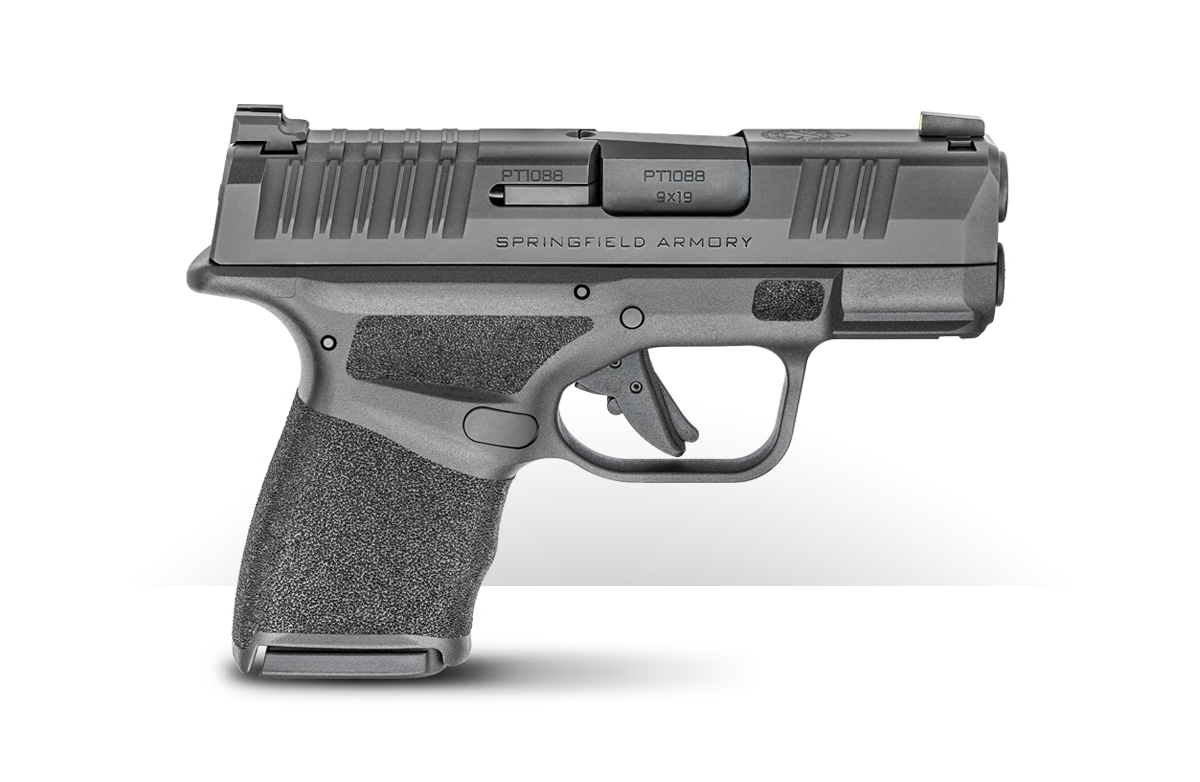
Just about all of us here also know that Springfield Armory later tipped the CCW world on its head with the release of the micro-9mm Hellcat in 2019, mating an 11+1 flush-fit magazine to a 3” barrel — as well as a slide and frame only an inch wide.
Fuzzy Boundaries
Today, we’re seeing more firearms on the market that have resulted from “scaling up” subcompact guns rather than rebating the dimensions of full-sized pistols; for example, consider how the original Hellcat provided the blueprint for the Hellcat Pro. Does this make the Hellcat Pro a “compact” gun? I think it does.

Similarly vexing: how would you classify a handgun with a chassis system and interchangeable frame/backstrap sizes like the Springfield Echelon? Such a gun can be “embiggened” or “smallified” to suit the owner’s tastes.
At least for now, the full-size/compact/subcompact hierarchy of handgun categories seems to have crystallized, perhaps in the absence of ironclad logic or the totality of historical circumstance. Suffice it to say, there’s a whole lot to consider about these classifications — and how they meet a handgunner’s anticipated needs — beyond simply being big, medium, or small.
Editor’s Note: Please be sure to check out The Armory Life Forum, where you can comment about our daily articles, as well as just talk guns and gear. Click the “Go To Forum Thread” link below to jump in and discuss this article and much more!
Join the Discussion
Featured in this article


Read the full article here