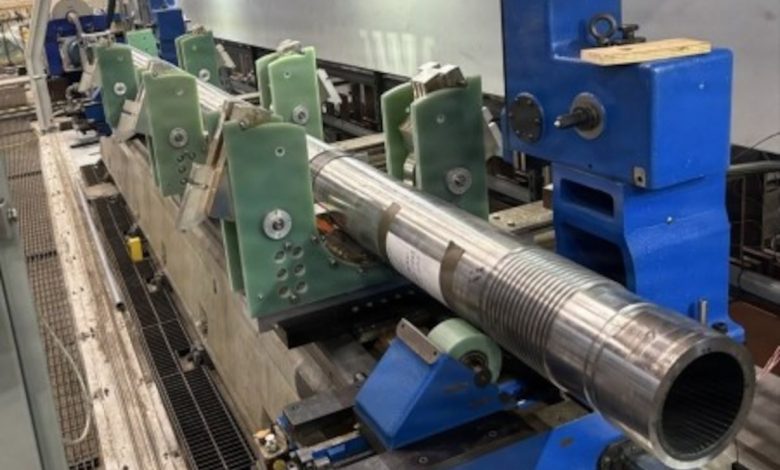

The Army has developed a new technique for cutting rifled grooves inside 155mm howitzer barrels that officials say could extend cannon life, improve performance and reduce manufacturing costs.
The process, demonstrated earlier this year at the Army’s Benét Laboratories in New York, uses electrochemical machining, or ECM, to carve the barrel’s 48 spiral grooves without the cutting tool ever touching the steel.
Officials said the no-contact technique leaves the bore in ideal condition for bonding a protective coating that shields the barrel from the extreme heat and erosion generated during firing.
“The protective coating applied to the bore is the primary defense against the extreme thermal and erosive environment inside a firing cannon,” said Christopher Mulligan, a materials engineer at Benét Laboratories.
“Without a perfect bond, the protective coating would fail under the stresses generated by high-energy propellants used in modern artillery and quickly degrade the underlying barrel steel,” he added.
Instead of cutting hardened steel with conventional tooling, ECM uses a cathode cutter, salt water and low-voltage electricity to dissolve metal. In a single pass, the process cuts all 48 rifling grooves inside an M284 cannon barrel.
Christopher Humiston, ECM project lead at Benét Laboratories, called the process “a significant advancement in cannon production” because the cutting tool experiences virtually no wear, reducing maintenance costs and the need for replacement tooling.
He added that ECM also allows engineers to produce complex rifling profiles that were previously impossible to manufacture, including grooves with varying depths in hardened steel.
Army officials said the technology was developed through a partnership between Benét Laboratories, part of the U.S. Army Combat Capabilities Development Command Armaments Center, and its industry partners.
The Army plans to install an ECM machine on the production line at Watervliet Arsenal, a more than 200-year-old facility and the Army’s only manufacturer of cannon barrels.
As demand surged following Russia’s invasion of Ukraine, Congress approved $1.7 billion to modernize the arsenal and expand its production capacity.
Daniel Terrill is a contributor to Military Times. He’s been reporting on military issues, the gun industry, and the outdoors for nearly two decades. Although writing is his passion, he’s been a Marine, police officer, and, perhaps the most dangerous job of his career, a substitute teacher.
Read the full article here