
A lawmaker whose Marine nephew took his own life in 2011 after being hazed by unit members in Afghanistan has introduced a new bill that initiates the process for making hazing a dedicated offense under military law.
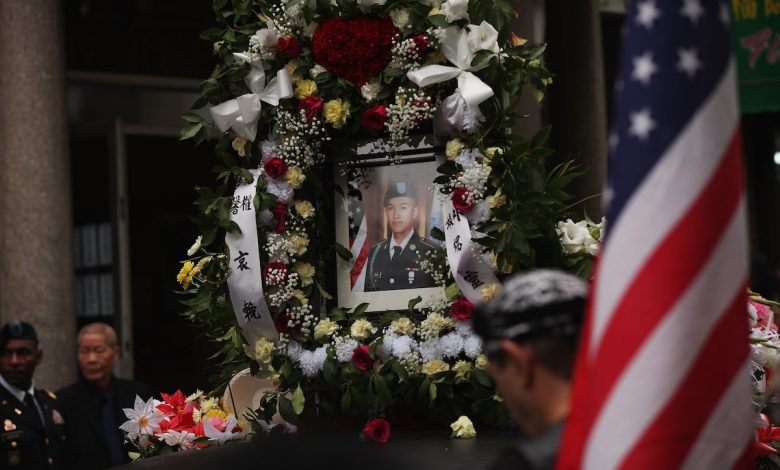
The Harry Lew and Danny Chen Military Justice Reform Act, introduced today by Rep. Judy Chu, D-Calif., is named for Chu’s nephew, Lance Cpl. Harry Lew, and Chen, a 19-year-old Army private who also died by suicide in 2011 after racial harassment and hazing.
The bill would order the Joint Service Committee on Military Justice to conduct a report to Congress on a change to the Uniform Code of Military Justice on whether hazing should be a standalone crime.
Currently, hazing offenses are charged under different articles of the UMCJ, such as Cruelty and Maltreatment (Article 93), intended to protect military subordinates from abuses of authority by their superiors; or Assault (Article 128).
A statement from the family of Chen, released by Chu’s office, expresses a desire to “carry on his legacy” by fighting military hazing.
“Our family does not want anyone to suffer the way Danny did,” the statement continues. “What was done to Danny and Lance Corporal Harry Lew was brutal and destructive. Danny will never return home to us and we do not want any other family to experience such senseless death from hazing.”
An investigation found the mistreatment leading to Chen’s suicide included racial slurs and being made to crawl over 100 meters of gravel while other soldiers threw rocks at him.
Lew was subjected to three-and-a-half hours of “corrective training” after he was found to have fallen asleep on post while on guard duty in Afghanistan. Marines also poured the contents of a sandbag into his face and mouth and battered him with kicks and punches.
He took his life with his service weapon shortly thereafter.
The new bill, which is cosponsored by Reps. Jill Tokuda, D-Hawaii, and Dan Goldman, D-N.Y., and has a Senate companion bill introduced by Sen. Kirsten Gillibrand, D-N.Y., comes seven months after Secretary of War Pete Hegseth called for rougher training by drill instructors at service boot camps.
Hegseth said the Pentagon would conduct a review of the military definitions of hazing and bullying to ensure they weren’t overly broad and said he’d allow boot camp trainers to “put hands on recruits” and “swear.”
RELATED
“Of course, you can’t do, like, nasty bullying and hazing,” Hegseth told an auditorium of generals and admirals in Quantico, Va. last September. ”We’re talking about words like bullying and hazing and toxic. They’ve been weaponized and bastardized inside our formations, undercutting commanders and NCOs. No more. Setting, achieving and maintaining high standards is what you all do. And if that makes me toxic, then so be it.”
In an exclusive interview with Military Times, Chu said she’d renewed her longtime efforts to fight military hazing after Hegseth’s speech.
“So far, the DoD has not made official changes to the definition of bullying, hazing, or harassment, but I am alarmed that he would bring back this idea that you should physically punish people and torture them, in essence, in order to make them soldiers,” Chu said. “So that is what has prompted my action in terms of introducing this bill.”
Chu led a group of 28 congressional Democrats in writing a letter of concern to Hegseth about his comments last year.
A response to the letter from Under Secretary of Defense for Personnel and Readiness Anthony Tata expanded on Hegseth’s comments, telling lawmakers that “by providing definitions that focus on the egregious misconduct described in your letter, leaders will be empowered to more easily address inappropriate conduct that does not constitute hazing or bullying while focusing resources on preventing and addressing incidents of hazing and bullying.”
Chu said that she wasn’t satisfied with the response.
“Narrowing the definition of military hazing, leading to a decrease in the number of unsubstantiated complaints, that does not make sense,” she said.
It’s not entirely clear what it would take to criminalize hazing under the UCMJ, particularly because the word can span such a broad range of behaviors, from bullying and verbal harassment to physical assault. Chu said the study, which is required to make a change to the military’s criminal code, would help to address this and create parameters for addressing hazing at different levels.
“I strongly believe that respect, professionalism, and accountability make our military stronger, and abuse and humiliation do not, and that service members perform best when they know they will be treated with dignity and protected from abuse, abuse by their peers and leaders,” Chu said.
Read the full article here