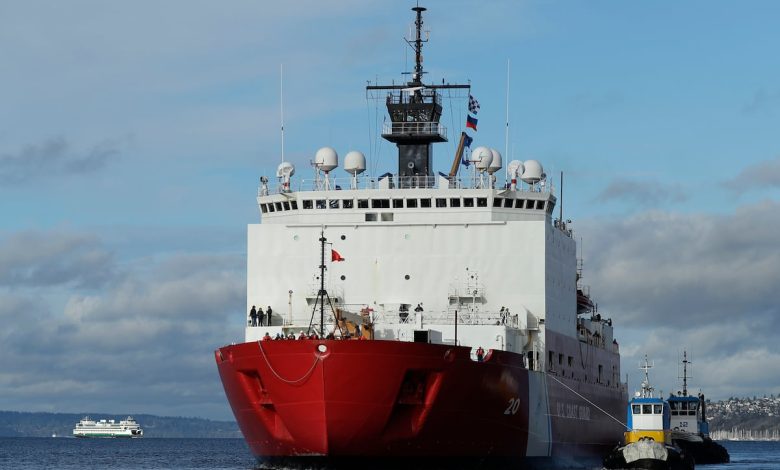

The Coast Guard’s medium icebreaker Healy was towed to Port Angeles, Washington, earlier this month as a result of a “significant engineering casualty,” according to a release.
The Cutter Healy, which recently completed drydock repairs at the Swan Island shipyard in Portland, Oregon, lost propulsion during sea trials off the Washington coast July 13 and was towed to port without incident. Coast Guard officials said no personnel were injured in the mishap.
The 420-foot ship underwent a $18.3 million overhaul earlier this year that included restoring propulsion components such as shafts, bearings, seals, rudders and its bow thruster. Vigor Marine LLC also upgraded the ship’s sonar system and infrastructure, according to a company release.
An investigation into the incident is underway, and the Healy is expected to need “major repairs,” the Coast Guard says.
The Coast Guard did not provide information regarding the extent of the damage or an estimated time for repairs.
“[The Coast Guard] will provide additional information regarding the casualty aboard CGC Healy as it becomes available,” the service told Military Times on Wednesday.
Coast Guard Commandant Adm. Kevin Lunday praised the Healy crew for acting “with speed and skill in responding to this casualty.”
“The nation needs a highly capable icebreaking fleet operated by the Coast Guard to ensure year-round access to the region to protect our northern border in Alaska and maritime approaches in the Arctic,” Lunday said in the release.
The Coast Guard icebreaker Storis, a commercial vessel that was purchased by the service and converted for Coast Guard use last year, is patrolling the Arctic region in Healy’s absence as is the national security Cutter Munro, which began tracking two Chinese vessels earlier this month as they passed through the U.S. Exclusive Economic Zone and the extended U.S. continental shelf in the Bering Sea, service officials said.
“Munro’s efforts advanced Operation Frontier Sentinel, which is designed to protect American sovereign rights, ensure consistency with international law, and position the Coast Guard to rapidly respond to any detected malign activity,” a spokesperson told Military Times.
The transits marked the first incidents in 2026 of Chinese vessels in the region.
The Coast Guard has stepped up acquisitions of icebreakers in response to growing concerns of foreign interests in the region and an executive order signed on Oct. 8, 2025, by President Donald Trump that ordered the Department of Homeland Security to increase the number of icebreakers available for patrolling the Arctic.
Bollinger Shipyards is building the first of three polar security cutters, but that program has faced a number of delays as a result of changes in contractors and engineering and design alterations.
The first of the class is now expected to be delivered in 2033, nearly a decade after its original target date, according to the Government Accountability Office.
To accelerate acquisition of additional icebreakers, the service awarded a contract in February to Davie Defense, Inc., for five additional cutters, bringing the total number under contract to 11.
The 27-year-old Healy has previously been sidelined by engine issues. In 2020, it suffered a fire in a propulsion motor, ending its planned deployment and experienced another fire in August 2024, also while underway.
Patricia Kime is a senior writer covering military and veterans health care, medicine and personnel issues.
Read the full article here