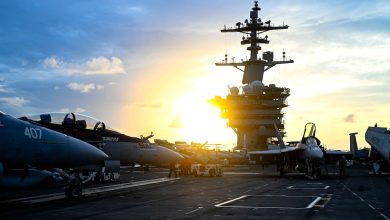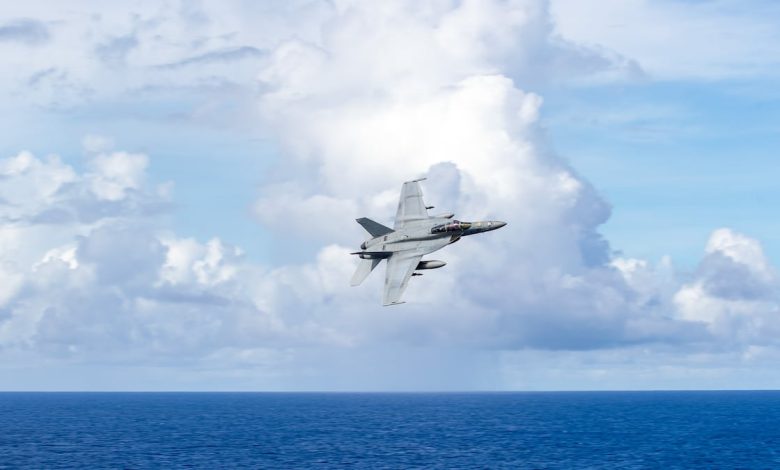

For the past 10 days, naval aviators across six squadrons attached to the aircraft carrier USS George Washington and carried out the time-honored tradition of field carrier landing practice — on Iwo Jima.
Since 1991, Iwo Jima, known today in Japan as Iwo To, has been the practice site of “touch-and-go” landings for pilots looking to hone their skills and for those seeking to be qualified for carrier landings.
Naval aviators must complete a minimum number of repetitive touch-and-go landings at airfields, which simulate landing on an aircraft carrier.
“FCLP is required flight training that precedes carrier landing operations and simulates, as near as practicable, the conditions encountered during carrier landing operations,” according to the Navy.
F/A-18 Super Hornet pilots with Carrier Air Wing 5, based at Marine Corps Air Station Iwakuni, near Hiroshima, took to the skies — and briefly the land — to polish their skills over the past week prior to the USS George Washington setting off on its annual patrol on May 10.
The George Washington is the sixth Nimitz-class nuclear-powered aircraft carrier and serves as the nation’s only premier aircraft carrier forward-deployed to Japan, according to the Navy.
During FCLPs, senior pilots typically fly a minimum of six sorties — three daytime flights and three at night — with at least seven touch-and-go landings. Junior pilots with less experience are required to undergo more extensive training, completing a dozen or more touch-and-goes before going on patrol.
Iwo Jima — where 6,000 American servicemen died during the savage monthlong fight for the island — provides ideal conditions for naval aviators to practice their craft.
The temperamental weather that the Marines faced on Iwo in 1945 remains closely similar to today, helping simulate the challenging conditions aboard a carrier in a pitching sea.
Poor weather conditions were once again at play on Friday, with rain showers forcing flight operations to halt temporarily. Practice concluded three days later on Monday after beginning May 9.
“Iwo To is a fantastic replication of the aircraft carrier,” Cmdr. Andrew “Mr. McDribblets” Ginnetti, told reporters on the island, according to Stars and Stripes.
“Obviously, it’s remoteness from a noise abatement aspect is important; however, the ability to own an airfield for an entire day allows us to get a whole bunch more landings without having to share it with other departure and arrival traffic,” Ginnetti continued.
Flying at Iwo Jima does not come without risk. The Navy requires pilots to sign a waiver that delineates that there is no alternate landing field and there can be no diversion, Ginnetti said.
“When we take off out of Iwo To the only place we can land is Iwo To just based on the fuel we take off with,” he said.
Claire Barrett is an editor and military history correspondent for Military Times. She is also a World War II researcher with an unparalleled affinity for Sir Winston Churchill and Michigan football.
Read the full article here