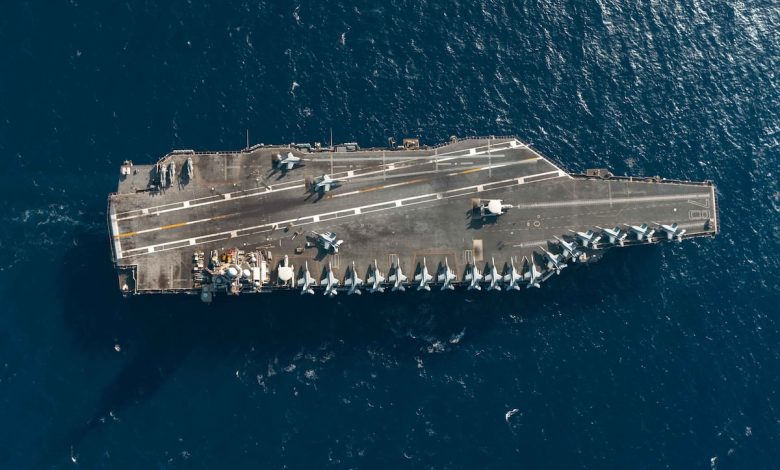

The system designed to assist sailors’ mental health aboard deployed U.S. Navy aircraft carriers is unable to meet the demand of prolonged combat deployments, according to current and former military personnel.
Sailors and U.S. Navy mental health professionals told Military Times that long wait times to see a provider, along with an insurmountable caseload for therapists and misguided treatment, stressed a system that was never built to handle the mental toll of extended military operations in contested environments.
Navy therapists are trained to provide consistent care, but that approach is often unattainable on a ship with so many sailors in need of assistance.
“The practice does not really match the [needs] of the ship that needs quick response, quick triage and longer sessions,” said one Navy mental health professional who was aboard an aircraft carrier during an extended deployment.
Several individuals who spoke to Military Times were granted anonymity for fear of reprisal from the U.S. military.
Service members can sometimes wait weeks for an appointment, a timeline that does not align with at-sea environments that require quick crisis management, according to the mental health professional.
The Navy also deploys a limited number of personnel who assist thousands of sailors onboard a ship, a ratio that worsens wait times, therapist burnout and effectiveness of care.
The heavy administrative burden on providers frequently buries them in paperwork, which they say adds to disillusionment about whether the job even makes a difference. Retention of mental health professionals is degraded in turn, according to sources.
In August, Military Times reported that two sailors attempted to jump overboard from the aircraft carrier USS Abraham Lincoln during a deployment that, at the time, was stretching into its ninth month.
At a town hall meeting in San Diego, California, that month, military family members expressed concern to Navy officials over food shortages and declining morale eroding the mental health of the ship’s crew.
The service said at the time that the ship had five chaplains, one clinical psychologist, one clinical social worker, three behavioral health technicians and an embedded integrated prevention coordination counselor.
The Navy reportedly reassured families at the August meeting that more mental health professionals were being sent to the ship.
But a sailor aboard the Lincoln during the deployment said that an onboard resiliency counselor left six months into the deployment for personal reasons and had not been replaced by the time the ship arrived in Thailand for a port call three months later on Sept. 2.
Beyond capacity
Deployed resiliency counselors, or DRCs, are licensed civilian mental health clinicians embedded onboard ships during deployments to provide additional mental health resources to service members.
After the Lincoln DRC’s mid-deployment departure, 5,000 service members on ship were left with two licensed mental health clinicians.
But according to the Navy, the ratio of service members to therapists was in keeping with its evaluation of sailor needs.
The service had observed deployments over the last two decades to identify resources to devote to ships, according to Cmdr. Katie Pierce, a Navy operational psychologist who works on the Navy’s suicide prevention team.
“Approximately 1,600 to 2,500 personnel — one mental health person can handle,” said Pierce, who spoke at a suicide prevention media roundtable in Washington on Thursday.
But psychologists and DRCs aboard ships are often beyond capacity, sources told Military Times, with some bumping weekly hours from 40 to 90 to address needs.
Even when mental health professionals saw sailors, the bottleneck of other waiting patients meant sailors were not getting needed treatment.
Getting an appointment with a provider could take weeks, if not months, according to sailors who served aboard the USS Harry S. Truman and USS Abraham Lincoln during extended deployments.
“Unless you say you’re suicidal, you have to wait weeks for an appointment with the military mental health providers,” said the Lincoln sailor, who served during its recent deployment to the Middle East.
“The healthcare and mental healthcare of the Navy is abysmal,” said the Truman sailor, who deployed aboard the aircraft carrier during its 2024 deployment to the Red Sea.
The Truman’s eight-month deployment was extended twice amid combat operations against the Iran-backed Houthi rebels.
“There is not enough staff for the 3,000 to 5,000 personnel on board,” the sailor said. “It may take months to get an appointment, and when you are seen, you have, at maximum, two issues you can speak to your provider for.”
Sam Rodriguez, a former sailor who worked on shore in the medical evacuation unit at Naval Medical Center Portsmouth, Virginia, said a majority of personnel who come through that unit do so for mental health reasons.
Receiving mental health care in a timely fashion on shore was difficult as well, Rodriguez said. It was not uncommon for sailors to wait 54 days for an initial appointment.
The issue, however, extends beyond wait times.
“The mission of mental health in the military is really like, ‘How can we get you back to the mission?’” Rodriguez said. “Not ‘How can we take care of you?’”
Set up to fail
While sailors have access to various mental health professionals on board an aircraft carrier, each provides different levels of care, sources said.
Some ships feature a clinical social worker who provides ongoing care but not clinical assessments. Navy psychologists assist service members dealing with suicidal ideation, as well as service members who need psychiatric help. DRCs are independent contractors who work for the Navy and deal with sailors in need of clinical therapy.
The Navy currently employs 34 DRCs, 81% of the billet’s capacity, a service spokesperson said. DRCs, however, do not deal with service members experiencing suicidal ideation, the Navy mental health professional said.
Administering treatment also differs between roles.
Psychologists are Navy employees who work to return the sailor to their job, one source said. DRCs, meanwhile, work through psychological issues that may impact mental health, according to the Lincoln sailor and a former civilian psychologist for the Navy.
“If you’re going to be an active-duty psychologist, then you have to be really committed to the Navy’s mission — less about treating individual people and more about maintaining force health,” the civilian psychologist said.
Carriers also offer other channels for less involved psychiatric care, according to the Navy mental health professional.
Embedded integrated prevention coordinators, or non-therapist educators, can provide classes and workshops. Additionally, psych techs — enlisted sailors who have undergone some psychology training — assist with triage. Onboard chaplains administer basic counseling.
Beyond resource availability, the roles themselves are often hampered by bureaucratic headaches that make mental health careers less appealing, sources told Military Times.
Deployed resiliency counselors, for example, are intended to upload patient notes to the Fleet and Family Support Management Information System, the Navy mental health professional said. But spotty internet connectivity at sea often yields a mountain of backlogged paperwork that must be completed upon returning to shore.
That process can take months, the Navy mental health professional said.
Commander, Naval Installations Command, was evaluating methods to make that process more efficient, a Navy spokesperson said.
The two Navy mental health professionals who spoke to Military Times said the current mental health system on aircraft carriers positioned neither professionals nor service members for success during extended combat deployments.
Therapists and psychologists face a demand signal during military operations that overburdens them, they said, with too many patients and not enough time to treat them.
Sources also discussed a culture that, during an extended combat deployment, diminished mental health priorities, rendering the methods the military psychologists were trained on ineffective.
As civilian therapists, DRCs were trained to operate like onshore, civilian clinicians, according to the Navy mental health professional who deployed aboard aircraft carriers.
A typical work week as a civilian hovers around 40 hours, but sticking to that routine is nearly impossible aboard an aircraft carrier, where the goal is to help as many sailors as possible.
“The volume on an aircraft carrier is so much greater, and the need is so much greater,” the Navy mental health professional said. “[They] have to maintain the standard of practice while … also [having] a volume that is incredibly needy.”
The mental health professional said the current model was not adequate to address thousands of service members.
Unless dealing with a sailor experiencing suicidal ideation, the trained treatment for military psychologists more closely resembles therapy offered at a primary care facility, the civilian psychologist said.
There, a provider might inquire about sleep and negative thoughts without digging into underlying issues, the psychologist added.
“It’s not going to be adequate for people who are struggling with more severe depression or trauma.”
Riley Ceder is a Navy reporter at Military Times, where he covers issues directly affecting service members and their families, as well as breaking news.
Read the full article here