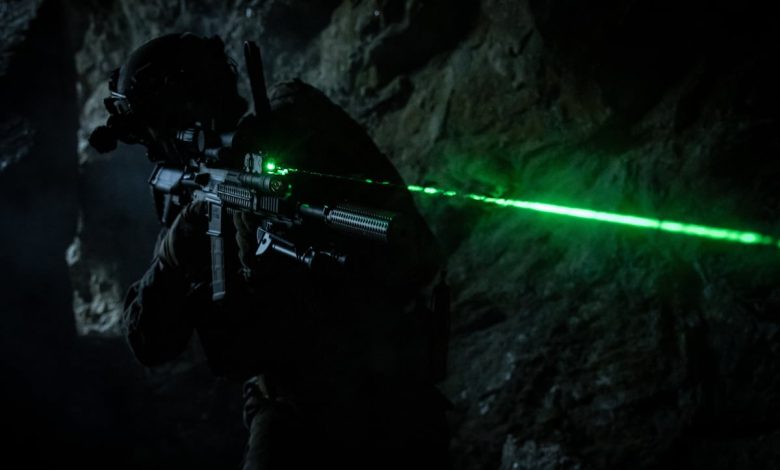

The Marine Corps started fielding a new laser aiming system for squad weapons earlier this summer, introducing the technology to students at the School of Infantry at Camp Lejeune, North Carolina.
In an August statement, Harry Mandeles, the service’s project officer for the Optics Team at Program Manager Ground Weapons Systems, called the Squad Aiming Laser, or SAL, a “generational leap” from the previous system, which had been in service for nearly three decades.
“Infantry Marines will notice significantly less eye strain and a much clearer target picture through their Night Vision Goggles (NVGs) compared to the legacy PEQ-16,” he said.
While both systems can be mounted to a weapon’s rail and project visible and near-infrared lasers, the two share few other similarities.
The SAL has an “ultra-compact” design, weighing approximately three ounces less than the legacy system and measuring nearly half an inch shorter.
Mounted to an M27 Infantry Automatic Rifle, or IAR, the lighter system improves the weapon’s overall balance and maneuverability, particularly during fast-paced operations.
But the Marine Corps says performance is the system’s biggest advantage. The SAL produces “a uniform, clean beam” that allows Marines wearing NVGs to identify targets faster and at greater distances.
The system also replaces the PEQ-16’s selector switch and activation buttons with all-digital controls.
Mandeles called that the transition to the SAL will represent a “fundamental shift” in how small units operate at night.
In February 2025, the Marine Corps awarded New Hampshire-based Envision Technology a $249 million contract to supply SAL systems and parts through 2030.
Roughly six months before, U.S. Special Operations Command, or SOCOM, awarded B.E. Meyers & Company a $49.9 million contract for a similar laser aiming system and for an even smaller design in 2025.
Daniel Terrill is a contributor to Military Times. He’s been reporting on military issues, the gun industry, and the outdoors for nearly two decades. Although writing is his passion, he’s been a Marine, police officer, and, perhaps the most dangerous job of his career, a substitute teacher.
Read the full article here