
Most people think of emergencies in terms of the disaster itself.
They think about the wildfire, the tornado, the blackout, the flood, the civil unrest, the house fire, or the sudden evacuation order. They think about what supplies they have, what tools they own, and whether they have enough food, water, medicine, and fuel to get through it.
Those things matter. But there is another problem that gets far less attention, and it can become dangerous in a hurry:
What happens when your family gets separated?
That is a far more common problem than many people realize. A father may be at work. A mother may be driving home. One child may be at school, another at practice, and a grandparent may be alone at home. When a crisis hits, everyone is suddenly trying to solve the same problem at once, often with incomplete information and under a great deal of stress.
Phones may not work. Roads may be blocked. Familiar places may no longer be safe. Children may panic. Adults may assume everyone else knows what to do, only to find out later that nobody was working from the same plan.
That is why every family should have a written emergency reunification plan, and why every responsible family member should carry a simple Emergency Family Wallet Card with the most important information on it.
Preparedness is also about reducing confusion, speeding up decisions, and helping your family regroup quickly under pressure.
Why Families Fail in Emergencies
One of the biggest weaknesses in most family preparedness plans is that they are too vague.
People say things like:
- “We’ll meet at the house.”
- “If something happens, call me.”
- “We’ll just head to your uncle’s place.”
- “If the power goes out, we’ll figure it out.”
That is not a plan.
A real emergency plan has to work when people are scared, tired, distracted, and not thinking clearly. It has to work when the power is out, when the roads are crowded, when cell towers are overloaded, and when one or more family members are not where they are supposed to be.
In other words, it has to work in the real world.
A good family emergency plan answers a few simple but critical questions:
Where do we meet first?
Where do we go if that location is unsafe?
What do we do if we cannot reach one another?
Who do we contact if local communication fails?
What information does each person need to carry?
If you do not answer those questions ahead of time, you are pushing all of those decisions into the middle of the crisis itself. That is the worst possible time to make them.
The Family Emergency Card Matters More Than Most People Think
This is where a wallet card becomes more than just a handy printable.
It becomes a practical survival tool.
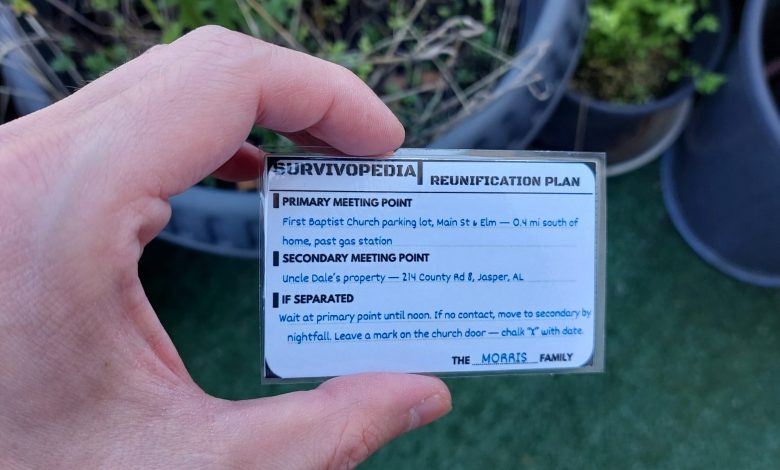
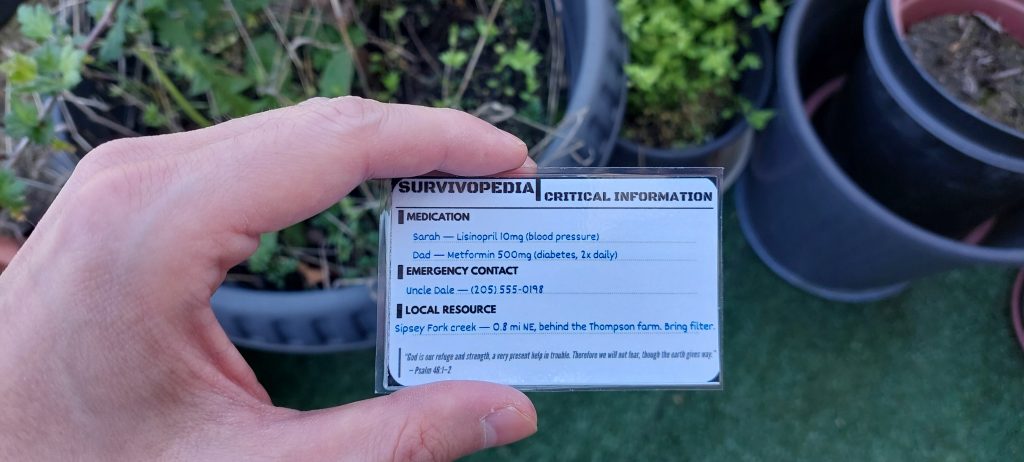
A well-designed family emergency card gives each person a small, durable reference they can keep with them at all times. It should include the family’s primary meeting point, secondary meeting point, instructions if separated, key medical information, an emergency contact, and one local resource or fallback note.
That may not sound like much, but in a real emergency, those few pieces of information can prevent hours of confusion and even save lives.
More importantly, this card should be given to all family members, not just the head of household.
That point deserves emphasis.
Do not make the mistake of filling out one card and tucking it into your own wallet as though that solves the problem. It does not. A family emergency card only works when the people who may become separated actually have the information in their possession.
Every responsible family member should have one.
That includes:
- husband and wife
- teen drivers
- older children who are mature enough to understand the plan
- grandparents living in the home
- adult children still under your roof
- caregivers who may be transporting children
- anyone else who may need to act independently during a crisis
If one person has the plan and everyone else is relying on memory, you do not really have a family plan. You have a single point of failure.
Why You Cannot Depend on Phones Alone
Modern families depend heavily on cell phones, and under normal conditions that makes sense.
But emergencies do not respect normal conditions.
Phones get left behind. Batteries die. Chargers are not available. Screens crack. Towers go down. Networks overload. Signal disappears. Even when the phone works, people under stress may not answer, may misread a message, or may give incomplete directions.
A printed emergency card solves a different problem than a phone does. It provides a stable, physical backup that does not depend on electricity, signal strength, or memory.
It also helps children and older family members who may struggle to navigate a phone under stress.
That is one reason I strongly recommend keeping the card in multiple places:
- wallet
- purse
- glove box
- school bag
- bug-out bag
- emergency binder
Redundancy is not paranoia. It is preparedness.
What to Put on the Card
The emergency card should be simple enough to read quickly and detailed enough to be useful.
At minimum, it should include the following:
Primary Meeting Point
This should be the first location everyone knows to head toward if the household is disrupted. Pick a place that is easy to identify, easy to reach, and unlikely to cause confusion.
Secondary Meeting Point
This is the fallback if the first location is unsafe, inaccessible, or unreachable.
If Separated Instructions
Keep these short and direct. In a crisis, long paragraphs become useless. One or two clear instructions are better than a page of explanation.
Medications or Critical Medical Notes
If a family member depends on medication, that information should be carried. In some families, this alone makes the card worth having.
Emergency Contact
This should usually be someone outside the immediate household and, ideally, outside the local area. In a regional emergency, an out-of-area contact can often succeed where local communication fails.
Local Resource
This may be a church, family property, nearby water source, supply cache, trusted neighbor, or known safe location. Keep it practical.
Family Name or Date Completed
This helps identify the card and reminds you when it was last updated.
Keep It Simple or It Will Fail
One of the worst things you can do is overcomplicate a family emergency plan.
In theory, a complicated plan may look smart. In practice, it breaks down under stress.
Children forget steps. Adults improvise. People take shortcuts. Somebody misunderstands something. Then the plan collapses at the first point of friction.
A good emergency card should use plain language, clear instructions, and familiar locations.
Do not write:
“Proceed to the alternate rendezvous point following initial regrouping failure.”
Write:
“If no contact by noon, go to Uncle Dale’s.”
That is the level of clarity you want.
Simple plans are easier to remember, easier to teach, and far more likely to be followed correctly.
This Card Should Be Reviewed as a Family
Filling out the card is not enough. You need to review it together.
Sit down as a family and talk through the scenarios.
Ask questions like:
- What if the house is not safe to return to?
- What if the roads are blocked?
- What if the phones stop working?
- What if one child is at school and another is with grandma?
- What if mom is at work and dad is out of town?
- What if we have to leave at night?
- What if one person reaches the meeting point and nobody else is there?
These conversations matter because they turn a printed card into a shared plan.
Children especially need repetition. You cannot explain the card once and assume they are ready. Walk through it. Show them the meeting locations. Practice the route. Explain the instructions in language they understand.
The same goes for older relatives. Never assume they already understand the plan. Review it with them carefully.
Every Family Member Should Carry One
It is worth saying again because it is one of the most important parts of this whole idea:
Give the card to all family members.
Not one. Not two. All of them who are old enough or responsible enough to carry and use it.
Print multiple copies. Fill them out clearly. Cut them to size. Laminate them if possible. Place one in every wallet, purse, vehicle, and go-bag.
A family card is not a decorative printable. It is a distributed emergency plan.
That is what makes it valuable.
If your wife has one, your teenage son has one, your daughter has one in her school bag, and you have one in your wallet, then your family has a much better chance of responding in a coordinated way.
If only you have the card, your family is still relying on you being present, reachable, and fully functional at the exact moment things go wrong.
That is not a system. That is wishful thinking.
Emergencies Change Fast. Written Plans Hold Steady.
One thing experienced preppers understand is that conditions can change fast.
The first meeting point may become inaccessible. The main road may be blocked. The expected threat may turn out to be something else entirely. A written plan with a clear fallback option gives you flexibility without chaos.
That is why the secondary meeting point matters.
That is why the emergency contact matters.
That is why the card matters.
The card does not eliminate uncertainty. It reduces it. And sometimes that is enough to keep a stressful event from becoming a full-blown family crisis.
How to Use the Printable Card
Once you download the printable card:
- Print it on card stock if possible.
- Fill it out clearly and briefly.
- Cut it to size.
- Laminate it for durability.
- Make enough copies for all family members.
- Review the card together.
- Update it whenever locations, medications, or phone numbers change.
Do not treat this as a one-time project.
A family emergency card should be updated just like the rest of your preparedness plan. If you move, change churches, switch schools, update medications, or lose a key contact, the card should change too.
Final Thought
A lot of preparedness advice focuses on equipment, and there is nothing wrong with that. But one of the smartest things you can do for your family costs almost nothing and takes very little time.
Write down the plan.
Make it portable.
Give it to everyone.
Because when an emergency strikes, families need clarity. They need fallback options. They need a shared understanding of what happens next.
That is exactly what this Emergency Family Wallet Card is designed to provide.
So download it, fill it out, print enough copies for all family members, and make sure everybody knows how to use it before the day comes when you need it.






Read the full article here