
When the American Expeditionary Forces joined the Allied armies on the Western Front in World War I, there was one condition upon which their commander, Gen. John Pershing, insisted. He wanted the AEF to fight as an army, not a collection of separated units scattered among the Allied armies. For the most part, he got his way by the time the United States’ First Army was launched against the Germans at Saint-Mihiel in September 1918.
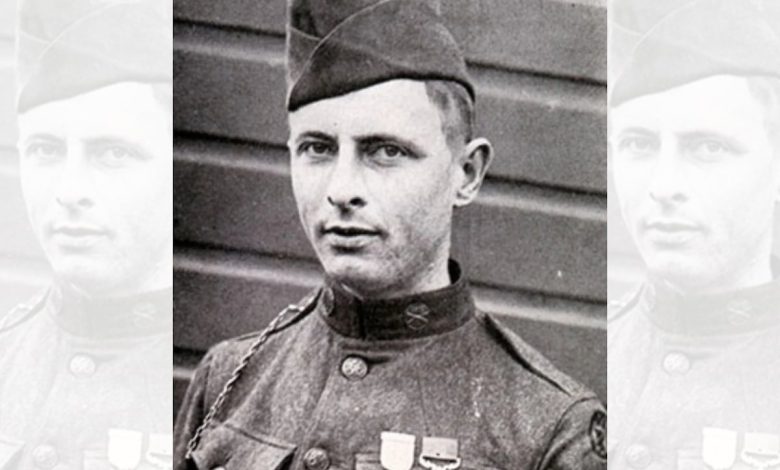
There were, nevertheless, a handful of American divisions that were “loaned” among the French, the British and the Australians, leaving their partners a general impression of naïve green soldiers capable of learning fast. Among those fast learners was Sgt. Reidar Waaler of Company A, 105th Machine-Gun Battalion, 27th Division, who entered the fray at Le Hamel on July 4, 1918.
Waaler’s peripatetic life story began on Feb. 12, 1894, with his birth in the Norwegian suburb of Oslo. A few years later, his family moved to resettle in New York City. Waaler had enlisted in the 27th Division, a New York National Guard unit, and had risen in rank to sergeant by the time his activated division was shipped overseas.
At Le Hamel the 27th and 30th divisions fought alongside the Fourth Australian Division under one of the most effective tacticians in the British Army: Lt. Gen. John Monash. By September, Monash had been knighted and was commanding the Australian Corps, taking the two American divisions with him.
As the British prepared to advance on the German Hindenburg Line, the infantry of the Australian 3rd and 5th Australian divisions and the U.S. 27th and 30th divisions were lent backup by British Tank Mark V battalions.
Since their debut on Sept. 15, 1916, the lumbering lozenge-shaped leviathans had proven unreliable — unreliable to control and vulnerable to enemy artillery. By 1918, however, they had been much improved and Monash found more things to do with their armored sides than provide gunfire support, such as bringing up fresh ammunition or bringing back the wounded.
On Sept. 27, the Allies moved up toward the Saint Quentin Canal and Péronne, with the 30th Division already having taken its objective. In spite of their demoralizing fallbacks, however, the Germans remained full of fight, inflicting casualties 3,076 out of the 18,055 American divisions in the sector in a matter of two days.
During fighting near Ronssoy, Waaler got a personal demonstration of even the newest tanks’ limitations as one of those supporting A Company was penetrated and began to burn — with a least two of its crew trapped inside. Waaler’s response was described in the citation:
“In the face of heavy artillery and machine-gun fire, he crawled forward to a burning British tank, in which some of the crew were imprisoned and succeeded in rescuing two men. Although the tank was then burning fiercely and contained ammunition which was likely to explode at any time, this soldier return to the tank and, entering it, made a search for the occupants, remaining until he satisfied himself that there were no more living men in the tank.”
The British push, with its two American assistant divisions, broke through the Hindenburg Line on Oct. 5, at which point the war was all but over, although fighting continued until Nov. 11.
On Feb. 4, 1919, Sgt. Waaler stood before Gen. Pershing at Chaumont to receive the Medal of Honor. In 1920 he married Gladys Evelyn Schutrum, but little further is known of his postwar activities, save that he died on Feb. 5 in Palm City, Florida, at age 84, and rests nearby at Forest Hill Memorial Park.
Read the full article here