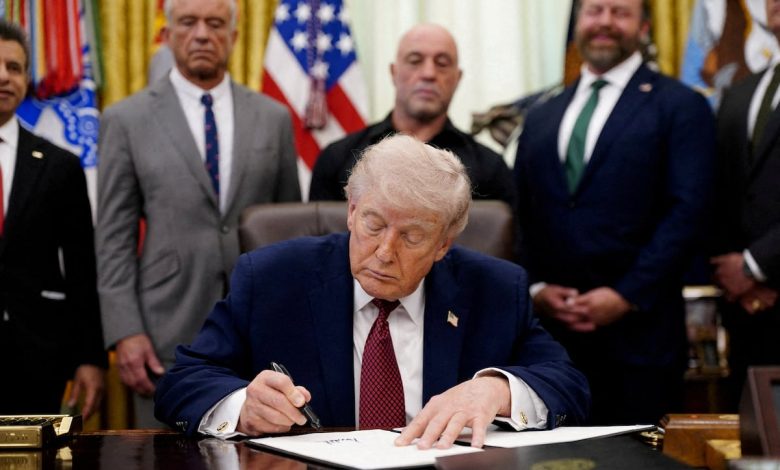

Sitting at the Resolute Desk in the Oval Office on Saturday, President Donald Trump described the quieter tolls of wars — one that follows veterans home and lingers long after the fighting ends.
“Since 9/11, we’ve lost over 21 times more veteran lives to suicide than on the battlefield,” he said. “Today, we’re bringing them new hope.”
Trump, in a declaration suffused with urgency, signed an executive order directing the Food and Drug Administration to accelerate the review of certain psychedelic therapies to treat mental illnesses.
Specifically, the order commits at least $50 million in federal funds to boost research on ibogaine, a powerful hallucinogen derived from the African shrub iboga.
Ibogaine is classified as a Schedule 1 substance in the United States — the same category as heroin — which means the Federal Drug Enforcement Administration considers it to have a high potential for abuse and no accepted medical use. Yet it has drawn mounting scientific attention in recent years for its potential to ameliorate conditions ranging from post-traumatic stress disorder to depression.
Much about the treatment remains opaque, but researchers argue the magnitude of the benefits observed in small, controlled trials merits further investigation. A 2024 Stanford University study of 30 special operations veterans with traumatic brain injury and repeated blast exposure found significant improvement in functioning, as well as an easing of PTSD, depression and anxiety symptoms after a single ibogaine session. No serious adverse side effects were reported, and no cardiac complications of the kind occasionally associated with the drug were observed. The authors cautioned, however, that larger studies were needed to better understand its safety and efficiency.
“If these turn out to be as good as people are saying, it’s going to have a tremendous impact on this country, and other countries, too,” Trump emphasized. “It’s for a lot of people, but it’s for our military in particular. The suicide epidemic among veterans is a national tragedy.”
Health Secretary Robert F. Kennedy Jr., appearing alongside Trump on Saturday, said, “We owe it to our war fighters and veterans to turn over every stone” to alleviate the mental health challenges stemming from their deployments. He acknowledged that the Schedule 1 restriction has caused veterans to seek treatment abroad, where ibogaine is legal.
“It’s disturbing to me and to the president that hundreds, in fact thousands, of veterans are having to travel to Mexico, or other countries, to experiment with interventions that hold great promise,” Kennedy added.
Trump’s directive would not immediately change the categorization of any substance. Instead, it aims to ease the regulatory constraints that have long stymied research, including for therapies already well advanced along the FDA’s approval process.
The Trump administration will also create a pathway for ibogaine to be “administered to desperately ill patients under the ‘Right to Try’ law.” This would permit patients with life-threatening conditions — who have exhausted all approved care — to access experimental medicine not yet fully supported by the FDA.
“I’ve always believed in ensuring that the American patients have access to breakthrough treatments and therapies with love for our veterans, and I have a real love for our veterans,” the president concluded.
RELATED
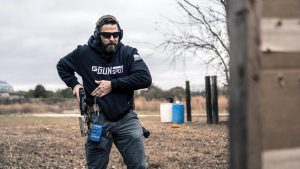
Marcus Capone, a Navy SEAL veteran with multiple combat deployments in Afghanistan and Iraq, told Military Times that he found relief in the unconventional treatment. He credits the intervention, without hesitation, for saving his life.
“Every time you come home from a war zone, you feel like you lose a little bit of yourself,” he said, recalling cycles of emotional volatility which encompassed anger and sadness. Over the years, he tried both pharmaceutical and non-pharmaceutical treatments, none of which proved to have long-lasting benefits.
As a last resort, his wife, Amber Capone, arranged for him to attend a medically supervised retreat in Mexico involving ibogaine. The treatment itself extends between six to 24 hours. Such sessions, he said, are psychologically demanding and physically taxing. At times, they can involve dark imagery and periods of intense emotional processing. But he insists that, for him at least, the gains were worth it.
“The psychedelic shows you not what you want to see, but what you need to see,” he explained. “So when you’re dealing with a traumatic experience, and you go revisit that, you deal with it. You get past the grief, the shame, and move on with your life. They actually get to the root cause of issues.”
The Capones have since established a foundation, Veterans Exploring Treatment Solutions, or VETS, focused on expanding safe access to psychedelic-assisted therapy for those who have exited the military.
“There is hope,” Amber Capone told Military Times. “It’s not a one-size fits all, it’s not for everyone even. But there is hope, and you can actually live rather than simply survive.”
Tanya Noury is a reporter for Military Times and Defense News, with coverage focusing on the White House and Pentagon.
Read the full article here