Unregulated prediction market may endanger US national security, experts and lawmakers warn

A U.S. Air Force F-15E Strike Eagle was shot down by enemy fire during Operation Epic Fury over southwestern Iran on April 3.
Two crew members ejected, landing miles apart from one another. While the U.S. was able to locate and rescue the pilot that same day, the weapon systems officer aboard remained unaccounted for.
A mad dash to save him ensued.
The officer, call sign Dude 44 Bravo, marched several kilometers, significantly injured and bleeding, evading the Iran’s Islamic Revolutionary Guard Corps headhunting him. The airman found refuge in a mountain crevice, hoping American troops would make it to him before Iran’s military did.
His life hung in the balance.
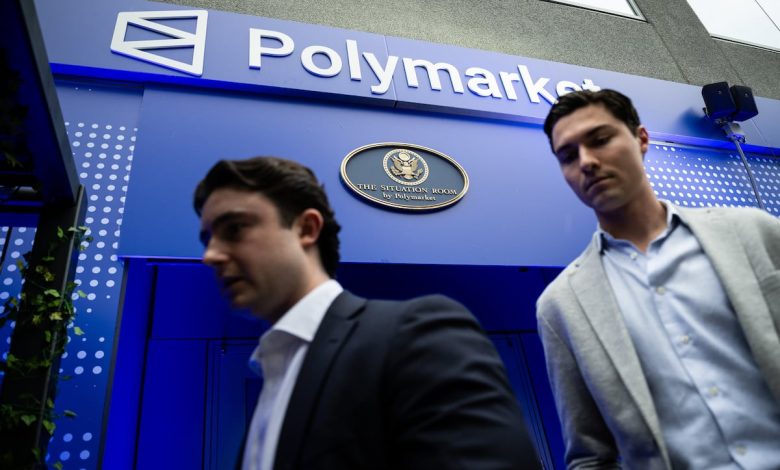
Meanwhile, individuals around the world were placing bets online, guessing which day the officer would be rescued. They did so on the prediction market Polymarket, hoping to cash out with the correct pick.
The pushback was swift.
U.S. Rep. Seth Moulton, D-Mass., a Marine Corps veteran, called the bet disgusting on X, and less than three hours later, Polymarket announced it had taken down the wager because it didn’t meet the platform’s integrity standards.
The weapon systems officer was rescued overnight from April 4-5 in a mission that included 155 aircraft supported by hundreds of special operations personnel. Polymarket bettors didn’t cash out.
“It should not have been posted, and we are investigating how this slipped through our internal safeguards,” read a Polymarket response to Moulton’s X post.
Markets are created by Polymarket’s own markets team with input from users and the community, according to the platform’s website.
Before and since the Iran war began, though, Polymarket has created war-related markets that users can bet on, raising concerns over the illegality and ethics of those specific bets. Polymarket did not respond to requests for comment.
Experts and lawmakers told Military Times that while the latter two concerns were front of mind, along with insider trading, the bets could also jeopardize national security.
Privileged information
Several days after the bet regarding the F-15E crew member was taken offline, U.S. Rep. Mike Levin, D-Calif., took to social media to express his dismay.
“Betting on the lives of our service members, on war, on assassination, and death is morally indefensible,” Levin said in a Facebook post.
During an interview with Military Times, Levin said he also had a problem with what many Polymarket bets insinuated: Anonymous traders might be using insider knowledge of massive military and war operations to turn a large profit.
On the first day of Operation Epic Fury, for instance, an anonymous Polymarket account under the username “Magamyman” made roughly $550,000 off of trades about the U.S. strikes against Iran and the removal of Iran’s Supreme Leader Ayatollah Ali Khamenei, who was killed by Israeli air strikes during the opening salvo of the Iran war.
“As a member of Congress, I have, I think, a fair amount of information that the public doesn’t,” Levin said. “I would have never in a million years thought that we’d be engaging in that sort of kinetic effort right then and there.”
Levin’s thinking was based off the briefings he’d received and President Donald Trump’s State of the Union address, he said. Based on that, he doesn’t believe that bets like this were the result of luck.
Insider trading wasn’t his only concern, though.
“Not only did they profit illegally, but I think they also may have exposed national security information publicly,” Levin said.
Manipulating state interest
Prediction markets don’t represent the likelihood something will happen, they represent the likelihood people think something will happen, according to Matthew Motta, an associate professor at Boston University’s School of Public Health who’s written about sports betting and prediction markets.
But if people believe the former statement, and not the latter, foreign adversaries or bad actors can take advantage of that dichotomy to thwart U.S. interests and strengthen their own, Motta told Military Times.
“Folks in the military may see movement on a prediction market as intelligence,” Motta said. “And if they do, then that information becomes rife for manipulation, because what can happen is that untraceable actors, perhaps actors with nefarious interests, can place money on an outcome that would be convenient for them.”
Unlike in sports gambling, where people might bet against a house in which a person or an algorithm sets the odds, people are betting directly against one another, which means they can directly alter the odds and the bet.
There was also the human element of greed.
Hypothetically, an intelligence official or military official could log onto Polymarket and place an anonymous bet on when a service member might be rescued or when a military operation might commence. They could then potentially make sure the military action they oversaw or aspects of a particular combat operation aligned with that bet to ensure they got a hefty payout without anyone knowing.
“That’s part of the nature of the problem is that a lot of this is being done through decentralized finance,” Levin said. “In this instance, it’s making it more difficult to determine exactly who is placing these bets and who’s making the money.”
Polymarket allows users to bet or trade shares anonymously by connecting their cryptocurrency wallets. While the amount bet or made is public, the identity of those receiving a financial windfall is not.
If adversaries started to count on this type of discord in which military or intelligence officials were using classified or non-public information to enrich their finances, it could reduce the lethality of U.S. war operations.
“If folks start to believe that these people are somebody working at the Pentagon or something, then you could imagine this might heighten the alert and reduce the element of surprise,” said Robert Ralston, a professor at the University of Birmingham’s Department of Political Science and International Studies who studies international security and has written about prediction markets.
Ralston also worried that concerns over Defense Department employees abusing privileged information for monetary gain could sew distrust among an American public that already might be skeptical of trusting government institutions.
If this inappropriate wielding of power was to be expected by Americans or adversaries, then adversaries might begin weaponizing technology to leverage those perceived weaknesses.
“As AI tools get better, it’s not a farfetched thing for a foreign government to create, essentially, a bot or a tool that constantly monitors … every Polymarket event contract related to Iran and try to find anomalous trades,” said Matthew Wein, a former policy advisor to the Department of Homeland Security.
The national security threat could also be scaled up, depending on the stakes of the wager, said Evan Cooper, a research analyst at Washington think tank Stimson Center.
Advisors or military officials with a direct line to the president could tip the scales in favor of going to war altogether, based off bets they’d made.
There were also other, stranger ways that market manipulation via Polymarket could potentially occur.
On November 15, 2025, a handful of Polymarket users placed bets on whether Russia would storm Myrnohrad in eastern Ukraine by the evening, despite there being no heavy indication that it would happen.
The markup on profit for some was reportedly 33,000%.
Several hours later, the bettors won.
But not because Russia had actually taken the city.
The Institute for the Study of War, a Washington think-tank which Polymarket allegedly sometimes utilizes for military cartography and information about the war in Ukraine, had inexplicably changed the map shortly before the bet ended to show that Russia made inroads into the city even though there was no information to support the edit.
Polymarket paid the bettors.
But the next day, the map’s edit was fixed, ISW acknowledged the error, and it appeared that the staffer responsible for it was fired.

Dubious bets
There have been several high-profile, well-timed bets on aspects of the Iran war that have yielded massive financial gains for users whose identities are unknown.
Fifty newly created accounts on Polymarket placed large bets on a U.S.-Iran ceasefire in the hours leading up to the official April 7 ceasefire that Trump announced on Truth Social.
They were the only bets those accounts had ever placed, and some accounts reaped hundreds of thousands of dollars in winnings as a result of their wagers.
Trump uploaded a social media post on Truth Social earlier in the day, claiming “a whole civilization will die tonight.”
A ceasefire was not widely expected at that juncture.
Another anonymous Polymarket user walked away with $400,000 after placing a bet in January that former Venezuelan President Nicolas Maduro would be ousted as the country’s leader hours before the U.S. captured him and transported him to the U.S.
Six Polymarket accounts made a total of $1.2 million betting that the U.S. would strike Iran, and many of the wallets placed the bet hours before the first strike. The wallets were funded only a day before the bets were wagered, according to an X post from visual analytics platform Bubblemaps.
“It is the wild west, which is why new rules need to be written,” Levin said.
If people were capitalizing on non-public information they’d gleaned through official duties to make money, it should be illegal, and they should be prosecuted to the full extent of the law, he said.
There were prior concerns over Polymarket’s legality before the Iran war.
The U.S. Justice Department and Commodity Futures Trading Commission launched investigations into the prediction market during former President Joe Biden’s administration. The platform was banned in the U.S. from 2022 to early 2025 after the CFTC settled charges against the company for not complying with regulations.
But those federal investigations were closed with no charges filed once Trump took office, and the prediction market was allowed to operate in the U.S.
There are also questions regarding conflicts of interest.
Trump’s eldest son, Donald Trump Jr., was appointed as an adviser to Polymarket in August 2025, and the venture capital firm 1789 Capital, where Trump Jr. is a partner, is also an investor in the company.
The current law, under the Commodity Exchange Act, makes it so that the CFTC possesses the authority to decide whether a betting contract should be taken down or violates current law that prohibits wagers on terrorism, assassinations or war.
Specifically, CFTC Regulation 40.11 cites that a CFTC registered entity cannot list for trading a contract that involves “terrorism, assassination, war” and or that is “contrary to the public interest.”
But there are several loopholes that allow individuals to bet on contracts that appear to deal with war and death and appear to violate this regulation, Levin said.
First, prediction markets can self-certify themselves and say they’re complying with the law, Levin said.
Polymarket maintains a Designated Contract Market license that the CFTC oversees, which allows the prediction market to self-certify and list new markets unless the CFTC takes issue.
Michael Selig, the chair of the CFTC, has defended the legality of prediction markets, announcing his support on social media and suing several states attempting to regulate prediction markets, claiming that it is the sole right of the CFTC to regulate them, and not the states.
During a hearing before the House Agriculture Committee — which oversees the CFTC — Selig said that his agency would bring anyone to justice engaging in insider trading.
Second, Levin said that Polymarket contends certain betting contracts that appear to hover around topics such as the death of leaders are actually regime change markets. This would allow the platform to circumvent CFTC regulations regarding assassination.
And third, Polymarket operates offshore, making it difficult for the CFTC to reach them, Levin said.
Ultimately, it’s up to the CFTC whether the contracts are in favor of public interest currently, but Levin disagrees that the power should rest solely with that government entity.
In response, Levin and U.S. Senator Adam Schiff, D-Calif., announced on March 10 the DEATH BETS Act, a bill that would make it illegal for a CFTC registered business to allow bets or contracts related to terrorism, assassinations, war or death.
“War is not a commodity, human life should never be traded on,” Levin said.
Riley Ceder is a reporter at Military Times, where he covers breaking news, criminal justice, investigations, and cyber. He previously worked as an investigative practicum student at The Washington Post, where he contributed to the Abused by the Badge investigation.
Read the full article here