
It’s been a problem as long as the existence of modern communications: Despite the need for commands to have accurate contact information for military spouses, some service members, military wives or husbands simply don’t want to be reached.
The failure of troops to provide phone numbers for spouses in the Air Force Personnel Accountability and Assessment System, however, can carry dire consequences. Chief of Space Operations Gen. Douglas Scheiss recalled an incident in which he and his wife, Debbie, needed to reach a spouse whose husband had died in Syria.
But when they called the number on file, the phone simply rang and rang. It was the number for the airman’s cell phone.
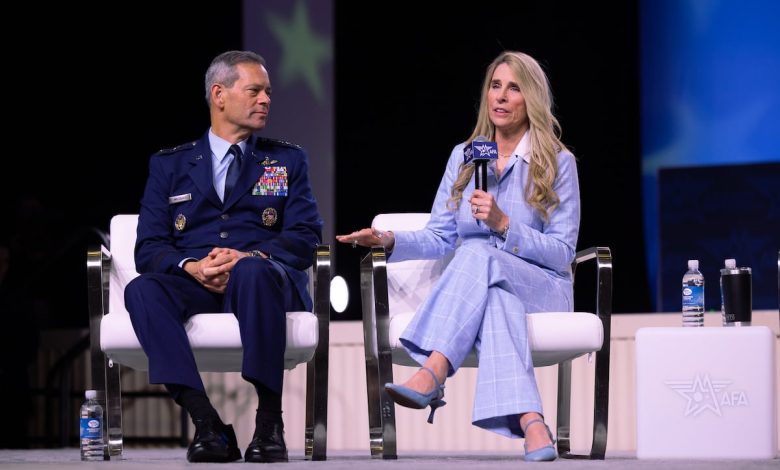
“The number we were calling [was wrong] because he didn’t want his wife’s number to be on something,” Scheiss said during a forum on military families at the Air & Space Forces Association annual conference in Oxon Hill, Maryland, on Wednesday. “We are the most connected people in the world … but when the time is needed to contact people … don’t take away that ability for a spouse to be connected.”
The Air Force is launching an effort to improve the service’s ability to collect accurate contact information for spouses and provide it to units’ Key Support Program, the Air Force’s volunteer portion of a command’s family readiness efforts similar to Navy ombudsmen or Marine Corps family readiness volunteers.
Key Support Liaisons facilitate communications between commands and families — and often serve as the social foundation for military families when units are deployed.
Volunteers are required to keep phone numbers and other personal information confidential under the Privacy Act, but the unit phone trees they are provided are only as good as the information in AFPAAS, explained Cindy Wilsbach, wife of Air Force Chief of Staff Gen. Ken Wilsbach.
“We’ve asked them to do this and [Key Support Liaisons] have stood up and said they will, yet we haven’t equipped them by giving them the contact information for our families,” Cindy Wilsbach said.
“When this thing kicked off in February,” she said, referring to the Iran war, “I heard from people around the globe … ‘Cindy, their spouse is gone, and this spouse has heard from no one. No one has contacted her, no one has reached out to her.’ It wasn’t just one or two people. I heard it from a lot of people.”
The service has started distributing cards to unit leaders that explain how leaders — most likely unit first sergeants — can pull unit personnel lists from AFPAAS and provide a comprehensive recall roster to their Key Support Liaison.
The four-step effort involves identifying the need, collecting the contact information, maintaining a roster and providing it to the liaison on a regular basis.
Collecting and distributing accurate information on family contacts may sound simple, but it’s been a problem “for a very long time,” Cindy Wilsbach said.
“We’ve heard it at every single base we’ve visited … so we’re hoping, with Legal’s blessing, that this is the way forward, that we will arm KSLs with the power to actually do what we’ve asked them to do,” she said.
Connection with the command, as well as one another, is a cornerstone of readiness, Cindy Wilsbach added. She said the liaisons are a vital resource for making initial contact with new families, sustaining families when units are deployed and providing support in emergencies.
The senior leaders and their spouses urged personnel attending the conference to keep their spouses’ contact information updated in AFPAAS, with Chief Master Sergeant of the Space Force John Bentivegna saying it’s the responsibility of leadership to make sure that spouses feel included.
“How many spouses … are maybe just waiting for someone to reach out to them. The worst that could happen is you send a note or make a phone call, send a text or an email, and you don’t get an answer back … but this is where leadership comes in — you got in there, and you got to take care,” Bentivegna said.
Patricia Kime is a senior writer covering military and veterans health care, medicine and personnel issues.
Read the full article here