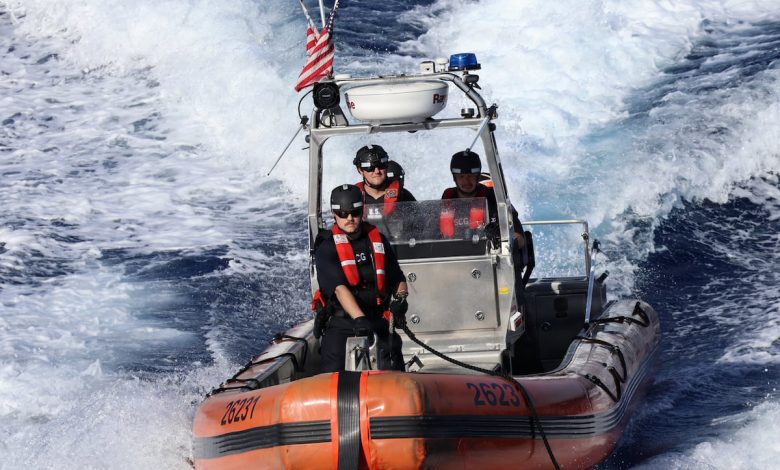

In the past week, some Coast Guard families have had their electricity shut off as a result of unpaid bills.
The Coast Guard, which oversees 6,000 family housing units, has been “begging” utility providers to keep the power and water on during a partial government shutdown that has hampered the service’s ability to pay its bills, Coast Guard Commandant Adm. Kevin Lunday said Tuesday.
Coasties scheduled to move this summer also have mounting credit debt as a result of restrictions on advanced pay for travel, and some have postponed medical treatment or delayed major expenses to avoid costs.
Civilian Coast Guard employees have fared even worse, according to leadership. One civil servant told Master Chief Petty Officer of the Coast Guard Phil Waldron that he sold his car to pay his rent in Ketchikan, Alaska, before emergency funding became available.
“Our total workforce has spent a majority of this fiscal year operating under uncertainty, fear and anger caused by a lapse of appropriations,” Waldron said during a hearing Tuesday on the Coast Guard budget. “The dangerous missions that our folks conduct every day … require their complete and total focus. That focus is dangerously fractured when they’re worried about paying their rent or supporting their families.”
The Coast Guard is the only U.S. armed service affected by the partial government shutdown that began Feb. 14 over a funding dispute for the Department of Homeland Security. While active-duty service members have continued to receive paychecks as a result of funding shifts, the Coast Guard has halted non-emergency operations and maintenance and cannot pay some of its bills.
The Coast Guard’s civilian employees — who number nearly 10,000 — went without a full paycheck from Feb. 16 through early April, when President Donald Trump signed an emergency order to pay them.
That emergency funding could run out this week, and the Senate and House of Representatives are again at an impasse over appropriations for DHS, including Immigration and Customs Enforcement and Customs and Border Patrol, the agencies involved in the killings of two U.S. citizens in Minnesota in January.
The uncertainty as to whether Coast Guard members and civilians will get paid at the end of this week is taking its toll, Lunday and Waldron told members of the House Transportation and Infrastructure Maritime Transportation Subcommittee.
Lunday said the stalemate is “needlessly harming our people and hollowing out our readiness.”
“The reality today is the Coast Guard is operating in a crisis, Day 74 of a DHS lapse in appropriations,” Lunday said. “This is taking on our people and their families, the severe hardship and uncertainty, not knowing whether they’ll be paid after this week.”
RELATED
House Speaker Mike Johnson, R-La., has said a bill that passed the Senate does not adequately address funding for immigration enforcement and promised Monday that a “modified version” would be agreeable to lawmakers on both sides of the aisle.
“We have to move DHA funding because it’s urgent … we are out of money,” Johnson told reporters Monday.
Rep. Rosa DeLauro of Connecticut, the ranking member of the House Appropriations Committee, predicted Monday that Homeland Security employees would be paid in early May but they will miss paychecks starting May 22 if an agreement is not reached.
She urged Johnson to support the Senate bill.
“The fastest way to ensure Secret Service, Coast Guard, Federal Emergency Management Agency, Transportation Security Administration, and Cybersecurity and Infrastructure Security Agency personnel are paid is for the Speaker to stop playing games and put the Senate bill on the House floor,” DeLauro said in a statement Monday.
Waldron also urged members to pass legislation to fund the department.
“I cannot stress enough the urgency for Congress to end this lapse and fully fund the U.S. Coast Guard,” Waldron said.
The Coast Guard has requested $15.6 billion for fiscal 2027, including $14.1 billion in discretionary funds that would support a 5% to 7% pay raise for members depending on rank, the service’s modernization and acquisition efforts and its goal to expand the service by 15,000 members.
According to Lunday, the budget also would fund childcare subsidies to service members, staff two child development centers and expand medical and logistics support at major installations.
It supports the work behind a $24.6 billion investment received last year for infrastructure improvements and acquisitions, and it includes $1.2 billion for procurement, construction and improvements.
The PCI funding would support development of the offshore patrol cutter fleet, changes to the Coast Guard cutter Storis — a commercial vessel purchased last year to augment icebreaker operations in the Arctic — and construction of three waterways commerce cutters.
The budget also would support service life extension projects for Coast Guard MH-60T helicopters and HC-144 surveillance aircraft and investment in command and control systems and shore infrastructure.
Lawmakers on the panel expressed support for the proposed budget but raised concerns that the service would be able to train additional personnel and maintain the manpower needed to staff new ships and aircraft.
Waldron said the budget provides $63 million to add roughly 300 new recruiters and open new offices, and $73 million to increase capacity across the training system. He assured representatives that the Coast Guard can support expansion.
“This will alleviate the immense strain on our training centers, which are currently operating above maximum capacity, and get our most junior members into their technical schools at a much faster pace,” Waldron said.
The House Appropriations Committee has not released its Homeland Security funding bill for fiscal 2027. The committee markup is scheduled for June 10.
Patricia Kime is a senior writer covering military and veterans health care, medicine and personnel issues.
Read the full article here