
The defense secretary’s recent removal of several qualified officers from the fiscal 2027 Navy O-7 Flag list should be of immediate concern to military personnel, veterans and to all Americans, regardless of political affiliation.
By now, it seems clear that the Navy approved, via a selection board, a list with 31 names on it. The final promotion list only contained 22. While this has not been confirmed by the Office of the Secretary of Defense, it seems clear that the names were removed by the secretary himself.
This is a line that has never been crossed before; no defense secretary in the past several decades has taken such drastic action.
While it is true that promotions have been withheld in the past — in the case of the Tailhook scandal and Fat Leonard investigations, for example — those were tied to alleged misconduct. This is not the case here; all 31 of those selected met the approved, merit-based standards of the selection board.
Additionally, the group removed included all of the women and several minorities, as well as some white officers who were originally selected. No reason was given, but some reporting indicates that a past association with diversity, equity and inclusion initiatives is a common denominator.
Regardless of the intent, the impact is clear: The makeup of this group of admirals will shape Navy leadership for decades to come.
To recap, the board president led his members to a decision under statutory guidance, a process that has been scrutinized and refined to the highest standard over the decades.
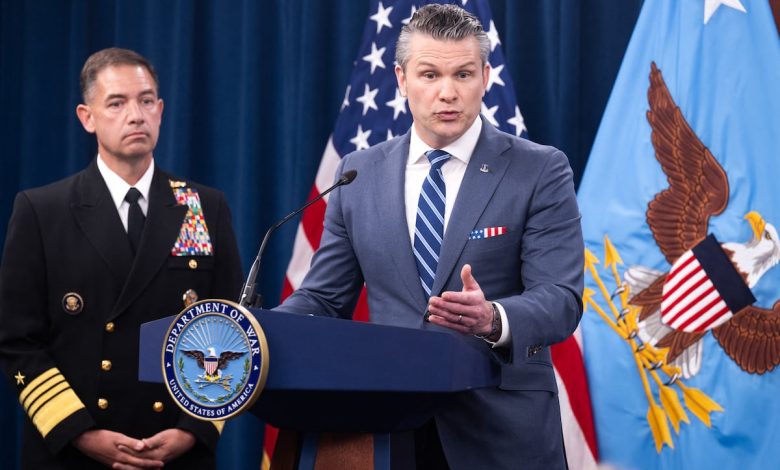
Defense Secretary Pete Hegseth’s actions effectively say that neither SECNAV nor a board of highly qualified flag officers are capable of delivering a list of the “best of the best” and that his judgment alone, without having reviewed records in the same detail, is better.
Hegseth has made it clear by his words and actions that he holds a strong presumption: If a woman or minority was promoted to a leadership position, it was solely because of their race or gender. The idea that it might have been based on merit is discounted.
If this new non-DEI standard imposed after the fact by the secretary is at the heart of the action, the trend will continue toward an all-white male admiralty that does not resemble or represent the force it leads. If nothing else, it creates a gap of nine flag billets while our nation is at war.
Many of us see this as a seminal moment for the Navy.
The actions of a single individual, taken without justification or explanation, demonstrate a dramatic and stark rebuke of Navy leadership, the Navy flag community, all of the individuals selected by the board for promotion and the board process, as well as its president and members.
If Navy leaders cannot decide who leads the service, how can anything they say or do be trusted?
This is a good spot to acknowledge a different perspective. A colleague with experience in such matters shared the following: “As a secretary, it’s one of the few levers you have to influence the future of the force … Previous administrations placed much more emphasis on diversity … There are a limited number of flag positions. Choices have to be made. Promotions can’t be entirely objective. They never really have been … Frankly, that is the Service Secretary’s and Sec War’s job.”
This may be true, but it this author’s opinion, it does not come close to justifying the recent unprecedented actions.
This situation transcends political alliances; even if the removals do not violate the letter of Title 10 and the secretary’s authority and responsibilities to Congress, it tramples on the spirit.
If the defense secretary wanted to shape the force in his image — white, male, straight, Christian — he could have duly inserted language into the precepts letter with transparency, and not hide behind the opacity of the office.
If he wanted to reduce the number of flag officers, as some have opined, Hegseth could have cut the number of available billets. I had hoped, perhaps naively, for a “Revolt of the Admirals,” some form of unified stand — or at least a louder hue and cry — from either the active duty or retired flag community, or even from the acting secretary of the Navy. But if there has been one, it has remained behind closed doors.
As many of those very flag officers have said many times (in person, in the same room as me), “When you walk past a discrepancy and do nothing, you have just established a new, lower standard”.
I agree. A lot of us are watching; recent articles and interviews have captured the pressures and fears expressed by female and minority active duty and retired service members. They also fall against the backdrop of other actions, such as the removal of high-ranking female and minority officers, a policy on shaving that impacts primarily Black service members and a drumbeat of questions about the suitability of women for combat roles.
As one officer said to me, “The cracks we put in the glass ceiling have now been repaired, and it’s more impenetrable than ever.”
Those words and the feelings behind them indicate a loss of trust in the integrity of the institution and those who lead it. These actions will filter down over time.
One Black sailor told me, “I submitted an officer package, but I feel my chances are now slim.” A very senior female officer told me that this action “chilled me to the bone. I cannot in good conscience advise young women to join a service where their opportunities are limited regardless of their talent.”
I feel especially bad for the 22 who were deemed “acceptable” for promotion. At some point they will be in the room with one or more of the other nine who met the exact same merit- and accomplishment-based standards. Will they look away? They should not be in this position; nor should the Navy.
I hope to see redress of this situation in some form, preferably the reinstatement of all 31 selectees. At a minimum, there should be a clear accounting for the reasons the other nine were removed.
It appears that Navy leadership is not prepared to die on this hill, which is disappointing but not unexpected.
There is still time for Congress to demand, and push for, answers. But the cement is setting, and this is starting to look like the new normal.
The foundation of the entire selection board process is cracked and may never recover. If so, it is a sad day for the Navy, the military and the country.
Dr. John Cordle is a retired Navy surface warfare officer (nuclear). He commanded the destroyer USS Oscar Austin and the cruiser USS San Jacinto during his 30-year military career and was recognized with the U.S. Navy League John Paul Jones Award for Inspirational Leadership.
Read the full article here