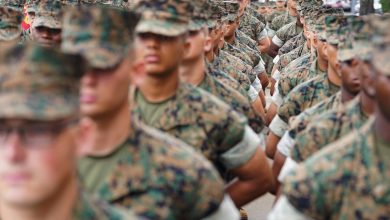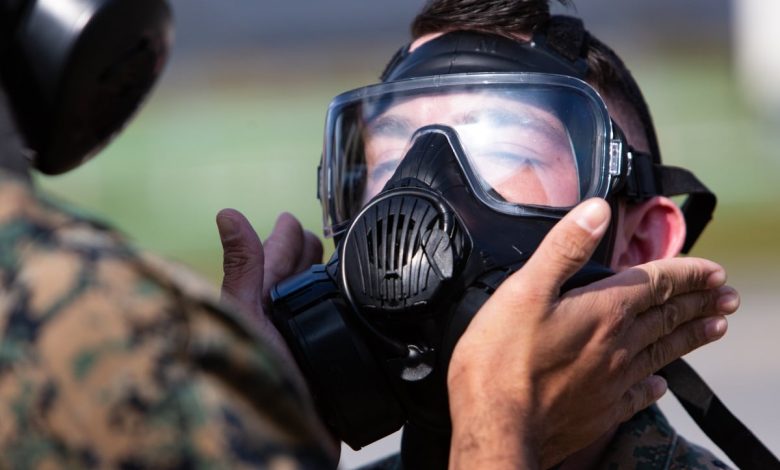

The Marine Corps and Navy will require personnel to undergo annual gas mask fit training beginning at the end of August, a move the services say is intended in part to “reinforce grooming compliance.”
The Aug. 21 announcement links the Marine Corps’ “uniform grooming standards” directly to “operational readiness and compatibility with protective equipment.”
In practical terms, the policy is intended to ensure Marines and sailors can establish a proper seal between their faces and gas masks, demonstrating that the fit is not compromised by facial hair.
The new requirement comes about 18 months after the services tightened restrictions on shaving waivers for personnel with medical conditions following directives from Defense Secretary Pete Hegseth.
In March 2025, the Marine Corps, for instance, ordered troops diagnosed with pseudofolliculitis barbae — commonly known as razor bumps — to undergo medical reevaluations. The policy also included language allowing the service to administratively separate Marines who required a medical shaving waiver for more than a year.
Critics have argued that the policy disproportionately affects Black service members and other people of color because of the higher rate of pseudofolliculitis barbae among these populations.
Kyle Bibby, a Marine veteran and co-CEO of the Black Veterans Project, said during a Congressional roundtable in July that the policy change could affect about two-thirds of Black service members.
He explained that while the servicemen who suffer from pseudofolliculitis barbae and need a waiver could be discharged, others who don’t have it as severely could face punitive issues.
“This is just one more thing for a commander to seize on — commanders who might not necessarily understand the intricacies of pseudofolliculitis barbae,” Bibby said.
Research generally supports the Marine Corps’ concern about facial hair and protective masks.
Studies have found that facial hair can significantly degrade the performance of close-fitting masks. However, other research found that how much facial hair interferes with a gas mask’s seal depends on factors such as hair length and density, and the type of mask being used.
In short, the latter study shows that people with facial hair can achieve an adequate seal with certain masks.
Under the new gas mask rule, commanders must validate the annual mask-fit training status of all assigned personnel by Aug. 31. They have until Sept. 30 to submit training plans for active-duty Marines and until Dec. 31 for reservists.
Daniel Terrill is a contributor to Military Times. He’s been reporting on military issues, the gun industry, and the outdoors for nearly two decades. Although writing is his passion, he’s been a Marine, police officer, and, perhaps the most dangerous job of his career, a substitute teacher.
Read the full article here