When I plucked the September-October issue of Smithsonian magazine out of my P.O. Box, the first article I turned to was “The Secret Life of Cormac McCarthy” by Richard Grant. As I skimmed it, a pull-quote leaped out at me: “He never left the house without a book. He never left the house without a gun. Both were equally unthinkable.”
“OMG,” I thought, “Cormac McCarthy was one of us!”
The article focused on the late Pulitzer Prize-winning novelist’s book collection, which ran over 20,000 volumes. It turns out many of those were gun books. The article includes a photo of one such, along with McCarthy’s hand-drawn plans for equipment to use to rifle one’s own gun barrels.
I looked first for the source of that pull-quote. Writer Grant was interviewing Cormac’s younger brother Dennis, who told him, “Cormac kept on ordering books after he was too sick and frail to read, because it was a compulsion, but until that point he would read for hours and hours nearly every day. He never left the house without a book. He never left the house without a gun. Both were equally unthinkable.”
Interviewer Grant asked, “Why was he always armed?” Dennis McCarthy replied, “He was a conservative country boy from the South who understood that the world is a dangerous place.”

Dennis McCarthy’s characterization of his brother as conservative will come as a surprise to many, since the author was famously reticent to discuss politics. “McCarthy’s writing can be read as either liberal or conservative, or as both simultaneously, depending on the politics that readers themselves bring with them to the act of reading the work,” David Holloway wrote in 2020 in “Cormac McCarthy in Context.”
Grant added, “He made money trapping muskrats around Knoxville and selling the pelts, and somehow also established himself as an authority on antique American rifles.”
The Guns of the McCarthy Novels
Cormac McCarthy knew how guns worked. What some call his masterpiece, “Blood Meridian,” was also without question his most violent book. Set in the year 1850, it focused on a 14-year-old boy, a runaway, who falls in with a murderous band of scalp-hunters led by a charismatic madman who some critics interpret as an allegory for Satan. McCarthy is said to have researched more than three hundred history books to get the details correct.

At one point the gang of killers comes into possession of a crate of Colt Dragoon percussion revolvers. Cormac McCarthy writes, “In his hand he held a longbarreled sixshot Colt’s patent revolver. It was a huge sidearm meant for dragoons and it carried in its long cylinders a rifle’s charge and weighed close to five pounds loaded. These pistols would drive the half-ounce conical ball through six inches of hardwood and there were four dozen of them in the case. Speyer was breaking out the gang-molds and flasks and tools and Judge Holden was unwrapping another of the pistols. The men pressed about. Glanton wiped the bore and chambers of the piece and took the flask from Speyer…”
McCarthy continues, “He charged the bores and seated a bullet and drove it home with the hinged lever pinned to the underside of the barrel. When all the chambers were loaded he capped them and looked about…”
Well, McCarthy knew how to load a cap-and-ball revolver, even if he didn’t care to hyphenate “long-barreled” or “six-shot.” But hell, we gun-writers differ as to whether it’s “sixgun” or “six-gun,” so I can’t pick on him for that.

If “Blood Meridian” is indeed the bloodiest novel in the McCarthy canon, “No Country for Old Men” has to be the “gunniest.” The movie, set in the year 1980, follows the novel quite closely. The protagonist is Llewellyn Moss, an ordinary guy, a welder and Vietnam vet who is out hunting antelope to start. The book is quite clear about what he’s hunting with:
“Moss sat with the heels of his boots dug into the volcanic gravel of the ridge and glassed the desert below him with a pair of twelve power german binoculars. His hat pushed back on his head. Elbows propped on his knees. The rifle strapped over his shoulder with a harness-leather sling was a heavybarreled .270 on a ’98 Mauser action with a laminated stock of maple and walnut. It carried a Unertl telescopic sight of the same power as the binoculars…The rifle would shoot half minute of angle groups. Five-inch groups at one thousand yards…The rifle had a Canjar trigger set to nine ounces…”

Live The Armory Life. The latest content straight to your inbox plus an automatic entry to each of our monthly gun giveaways!
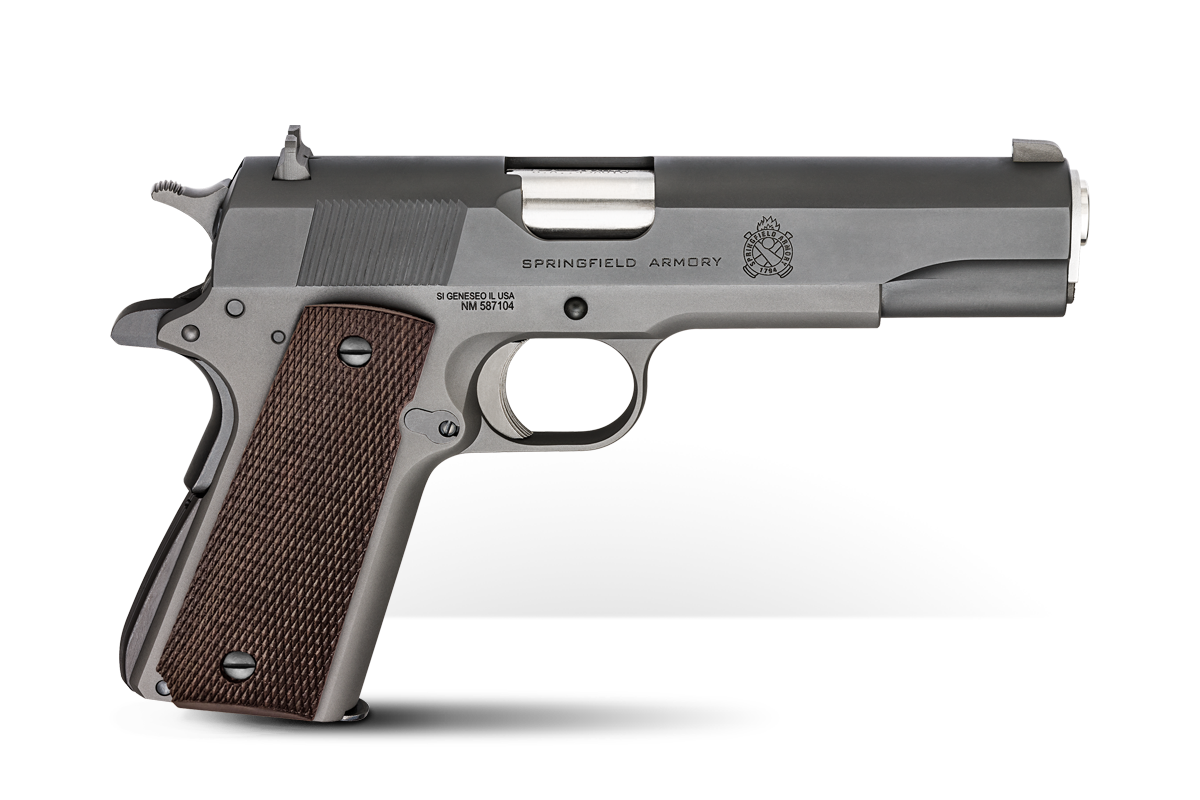
While hunting, he runs across the scene of a drug deal gone bad; dead dopers strewn everywhere next to their dropped guns. He finds – and takes – a valise with $2.4 million in drug money C-notes according to the novel, and also a dropped .45. McCarthy doesn’t say so but we can determine it’s a 1911 because he has to depress the grip safety to lower its hammer. He augments the .45 with a “shortbarreled (sic) H&K machinepistol with a black nylon strap.” He leaves with the money, not realizing the valise has a transponder.
Soon, a hit man is on his trail. While in hiding he buys a Winchester shotgun and a hacksaw with which to shorten barrel and stock. Describing the slide action and outside hammer, McCarthy leaves it to us to deduce that it’s some variation of an 1897 Winchester.
The movie rolls on. He is chased by a mysterious hit man named Anton Chigurh, whose signature weapons are a slaughterhouse pneumatic bolt gun and what Cormac McCarthy describes thus: “The shotgun was a twelve gauge Remington automatic with a plastic military stock and a parkerized finish. It was fitted with a shopmade silencer fully a foot long and big around as a beer can.”
Here’s a scene of one of Chigurh’s kills that doesn’t make it into the movie. “The man was holding a small pistol at the level of his belt. Chigurh stepped into the doorway and shot him in the throat with a load of number ten shot. The size collectors use to take bird specimens.” He tells the dying man, “The reason I used the birdshot was that I didn’t want to break the glass. Behind you. To rain glass on people in the street.” All heart, that guy.
A central character in the book is Sheriff Ed Tom Bell, the “old man” of the title who realizes he’s gotten too old for what his country has become. We’ll talk about his service sidearm shortly.
The Guns of the McCarthy Movies
The book that won him the Pulitzer was “The Road,” a chilling story of a father trying to protect his young son in a post-apocalyptic landscape of robbers and cannibals with only a revolver and two cartridges, for which he desperately and unsuccessfully scrounges for more ammo. A shooter’s nightmare, really. I haven’t read the book in years, but recall it being vague about the guns. In the movie of the same name, star Viggo Mortensen is armed with a pre-Model 10 Smith & Wesson Military & Police and, yes, two cartridges.
The book “No Country for Old Men” (copyright 2005) is much richer in gun description, and the movie version – which won four Academy Awards – is awash in weapons. UZIs. MAC-10s. (They mention finding .380 brass—should have been a MAC-11, but I digress.)

Sheriff Bell’s deputy carries a Pachmayr-gripped four-inch blue Smith & Wesson K-frame revolver with fixed sights, which would make it either a .357 Model 13 or .38 Special Model 10, the hammer spur being too short for a 9mm Model 547. The always useful Internet Movie Firearms Database website says it’s a Model 13.
Alas, some of the other guns would have had to come to that 1980 setting in a time machine. Chigurh’s imaginative Remington 11-87 wasn’t introduced until, you guessed it, 1987, and in 1980 no one made a working sound suppressor for a shotgun. McCarthy had probably envisioned a Model 1100.
In one scene in the movie Chigurh kills two men with what appears to be a Glock 19, which wasn’t introduced until 1988. I suppose we can forgive this; how many old cowboy movies did we enjoy that were set in the 1870’s and 1880’s where the actors were armed with 1892 Winchesters?
Let’s finish up with the sheriff’s gun. Ed Tom Bell is played by Tommy Lee Jones, armed (as Moss is early in the movie) with a 1911 .45. That’s true to the time and place. “No Country For Old Men” is set in Texas, where the Texas Rangers made the 1911 one of their signature guns almost as soon as it came out, and it is popular to this day among Texas lawmen who have a choice in the matter of their sidearms.
But one thing is glaringly wrong: any thinking cop with a 1911 would carry it cocked and locked and Sheriff Bell’s is worn hammer down, perhaps to allow for the dramatic cocking of the hammer in the one scene where he draws it.

This differs markedly from the book, where Sheriff Bell muses, “I still like the old Colts. .44-40. If that wont stop him you better throw the thing down and take off runnin.”
Now, even in 1980, a for-real Texas lawman who wasn’t in a ceremonial parade on horseback or something wouldn’t be carrying a Frontier Six-Shooter. He’d have at the least a double-action revolver, like the Colt New Service .44-40 Col. Charles Askins, Jr. finished some gunfights with when he was on the Border Patrol in the 1930s. But we know that Cormac McCarthy meant him to be carrying the old single action Peacemaker. He wrote of the sheriff, “He took the pistol from the holster and flipped open the gate and checked the shells in the cylinder and closed the gate with his thumb…”
Yup. That’s the old single action revolver.
And, To Finish With a Spoiler…
Fans of the movie debate the enigmatic scene near the end of the movie when Chigurh gives Moss’s widow his trademark live-or-die coin-flip choice. The scene then cuts to Chigurh leaving the house and checking the soles of his feet. It’s left up to the viewer to decide whether or not he has murdered her and is checking for blood on his shoes.
If the viewer is wondering, the reader is not. Cormac McCarthy made it quite clear in the book. She calls heads. Chigurgh flips the coin. It comes up tails. He philosophizes for a while, like a true psychopath.
And then, writes Cormac McCarthy, “He shot her.”
Editor’s Note: Cormac McCarthy’s writing style was distinct, frequently eschewing accepted uses of punctuation and capitalization. In this article, quotations from his works retain his original prose without correction.
Please be sure to check out The Armory Life Forum, where you can comment about our daily articles, as well as just talk guns and gear. Click the “Go To Forum Thread” link below to jump in and discuss this article and much more!
Join the Discussion
Featured in this article
Read the full article here